

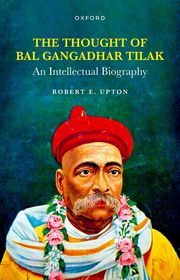
The Thought of Bal Gangadhar Tilak
An Intellectual Biography
- Publisher's listprice GBP 90.00
-
42 997 Ft (40 950 Ft + 5% VAT)
The price is estimated because at the time of ordering we do not know what conversion rates will apply to HUF / product currency when the book arrives. In case HUF is weaker, the price increases slightly, in case HUF is stronger, the price goes lower slightly.
- Discount 10% (cc. 4 300 Ft off)
- Discounted price 38 698 Ft (36 855 Ft + 5% VAT)
Subcribe now and take benefit of a favourable price.
Subscribe
42 997 Ft

Availability
printed on demand
Why don't you give exact delivery time?
Delivery time is estimated on our previous experiences. We give estimations only, because we order from outside Hungary, and the delivery time mainly depends on how quickly the publisher supplies the book. Faster or slower deliveries both happen, but we do our best to supply as quickly as possible.
Product details:
- Publisher OUP Oxford
- Date of Publication 10 July 2024
- ISBN 9780198900658
- Binding Hardback
- No. of pages334 pages
- Size 216x140x19 mm
- Weight 480 g
- Language English 527
Categories
Short description:
The Thought of Bal Gangadhar Tilak is a systematic study of Bal Gangadhar Tilak's thoughts, focusing on his views on 'communal' relations within the Indian polity, on caste and reform in Hindu society, and on political ethics regarding violence and non-cooperation.
MoreLong description:
This work is a systematic study of Bal Gangadhar Tilak's thought, focusing on his views on 'communal' relations within the Indian polity, on caste and reform in Hindu society, and on political ethics regarding violence and non-cooperation. The Thought of Bal Gangadhar Tilak adopts a contextualist approach, situating his ideas in local Maharashtrian as well as pan-Indian and global cultural-intellectual contexts. The approach blends Tilak's quotidian journalism and speeches alongside his canonical texts on Aryan history and on the Bhagavad Gita. The work marks a departure from current interpretations, emphatically arguing that he is misappropriated and/or misunderstood as a proto-Hindutva thinker. Instead, he is revealed to be a radical liberal who supports counter-autocratic violence, a majoritarian pluralist in terms of intercommunity relations, a self-strengthening reformer focused on masculinity, committed to reshaping India for the challenges of modernity— something fused in his thought with a resilient Brahmin supremacism. This book lays emphasis on his remarkable recognition as the nation's 'founding father' and particularly demonstrates how his appropriation by Gandhi was in turn contested by those emphasising Tilak's embrace of violence, particularly in the crucial mid-1920s period when he was indelibly linked to re-emerging Hindutva. More recently, growing ahistorical demi-official insistence on his social progressivism illustrates a change in India's public culture, as does the use of popular or even legal pressure to de-legitimize perennial criticism of Tilak's socio-political positions.
MoreTable of Contents:
Introduction
Intellectual Formation
Tilak as a Writer
The Nature of the Indian Polity
Reforming Hindu Society
The Conduct of Politics
Remembering Tilak
Conclusion
List of illustrations

