

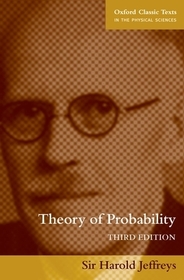
The Theory of Probability
Series: Oxford Classic Texts in the Physical Sciences;
- Publisher's listprice GBP 98.00
-
46 819 Ft (44 590 Ft + 5% VAT)
The price is estimated because at the time of ordering we do not know what conversion rates will apply to HUF / product currency when the book arrives. In case HUF is weaker, the price increases slightly, in case HUF is stronger, the price goes lower slightly.
- Discount 10% (cc. 4 682 Ft off)
- Discounted price 42 138 Ft (40 131 Ft + 5% VAT)
Subcribe now and take benefit of a favourable price.
Subscribe
46 819 Ft

Availability
printed on demand
Why don't you give exact delivery time?
Delivery time is estimated on our previous experiences. We give estimations only, because we order from outside Hungary, and the delivery time mainly depends on how quickly the publisher supplies the book. Faster or slower deliveries both happen, but we do our best to supply as quickly as possible.
Product details:
- Edition number 3
- Publisher OUP Oxford
- Date of Publication 6 August 1998
- ISBN 9780198503682
- Binding Paperback
- No. of pages470 pages
- Size 236x156x25 mm
- Weight 648 g
- Language English
- Illustrations tables 0
Categories
Short description:
Published in 1939, this book was the first to develop a fundamental theory of scientific inference based on the ideas of Bayesian statistics. Recent advances in computer power and availability have brought Bayesian statistics into the limelight and make this book a must for all serious statisticians.
MoreLong description:
Another title in the reissued Oxford Classic Texts in the Physical Sciences series, Jeffrey's Theory of Probability, first published in 1939, was the first to develop a fundamental theory of scientific inference based on the ideas of Bayesian statistics. His ideas were way ahead of their time and it is only in the past ten years that the subject of Bayes' factors has been significantly developed and extended. Until recently the two schools of statistics (Bayesian and Frequentist) were distinctly different and set apart. Recent work (aided by increased computer power and availability) has changed all that and today's graduate students and researchers all require an understanding of Bayesian ideas. This book is their starting point.
Though mathematically very demanding, the principles and examples are clear enough, and Jeffreys' trenchant references to critics of Bayesian methods often made me laugh out loud - an unusual experience with an advanced statistics text. Its selection as an Oxford Classic Text is unusual but well judged.
Table of Contents:
Fundamental notions
Direct probabilities
Estimation problems
Approximate methods and simplifications
Significance tests: one new parameter
Significance tests: various complications
Frequency definitions and direct methods
General questions

