

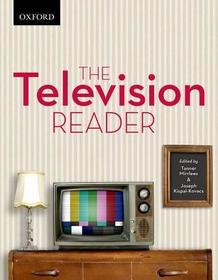
The Television Reader:
Critical Perspective in Canadian and US Television Studies
- Publisher's listprice GBP 39.99
-
18 055 Ft (17 195 Ft + 5% VAT)
The price is estimated because at the time of ordering we do not know what conversion rates will apply to HUF / product currency when the book arrives. In case HUF is weaker, the price increases slightly, in case HUF is stronger, the price goes lower slightly.
- Discount 10% (cc. 1 806 Ft off)
- Discounted price 16 249 Ft (15 476 Ft + 5% VAT)
Subcribe now and take benefit of a favourable price.
Subscribe
18 055 Ft

Availability
Uncertain availability. Please turn to our customer service.
Why don't you give exact delivery time?
Delivery time is estimated on our previous experiences. We give estimations only, because we order from outside Hungary, and the delivery time mainly depends on how quickly the publisher supplies the book. Faster or slower deliveries both happen, but we do our best to supply as quickly as possible.
Product details:
- Publisher OUP Oxford
- Date of Publication 1 October 2012
- ISBN 9780195446876
- Binding Unidentified
- No. of pages528 pages
- Size 177x228 mm
- Language English
- Illustrations 6 tables 0
Categories
Short description:
A core book for Television Studies courses at the second- and third-year university level, The Television Reader brings together contemporary writing in the field of Canadian and US television studies.
MoreLong description:
The Television Reader: Critical Perspectives in Canadian and US Television Studies is a core text for Television Studies courses taught at the second- and third-year level. With 27 chapters divided into four parts, our text brings together exciting and contemporary writing in the field of Canadian and US television studies. The Television Reader includes introductory essays and two brand new chapters written by the editors, as well as 25 previously published
articles. The selection of material covers economic, genre, historical, political, technological, and theoretical characteristics of Canadian and US television.
The first part of the text, 'Theorizing Television,' discusses theoretical approaches to studying television as a cultural form, a genre, and a mode of communication. Part II, 'History and Characteristics of TV Broadcasting in Canada and the US,' contains readings discussing the similarities and differences, from political and economic perspectives, that shape Canadian and US television. Part III, 'TV Genre: Contexts and Textual Analysis,' includes trendy, relevant readings on genre in
television. The fourth part, 'Emerging Trends in Television Studies,' examines the future of both general television and Canadian television. Finally, each part is accompanied by suggestions for further reading and chapter-specific discussion questions to further student engagement and
understanding.
Table of Contents:
Preface
Introduction: Making Critical TV Studies 'Visible'
Part I: Theorizing Television
Critical Approaches to the Study of 'TV': An Introduction
Tanner Mirrlees and Joseph Kispal-Kovacs
Discussion Questions and Suggestions for Further Reading
Part II: History and Characteristics of TV Broadcasting in Canada and the US: Political Economy
The Radio Act of 1927: Progressive Ideology, Epistemology, and Praxis. Mark Goodman and Mark Gring
Women's Work. Lynn Spigel
Canada. Marc Raboy
A Usable History for the Study of Television. Paul Attallah
Discussion Questions and Suggestions for Further Reading
Part III: TV Genre: Contexts and Textual Analysis
1. Sit-coms
From Trailer Trash to Trailer Park Boys. Dean Defino
Little Mosque on the Prairie: Examining Multicultural Spaces of Nation and Religion. Sandra Canas
2. Science Fiction
Downloading Doppelgängers: New Media Anxieties and Transnational Ironies in Battlestar Galactica. Mark McCutcheon
3. Cop/Crime shows
CSI and Moral Authority: The Police and Science. Gray Cavender and Sarah K. Deutsch
Rewriting Baltimore. Marsha Kinder
4. Reality-TV
Making the Most of 15 Minutes: Reality TV's Dispensable Celebrity. Sue Collins
Reality TV Formats: The Case of Canadian Idol. Doris Baltruschat
5. News Production and News Parody
Laughing at Authority or Authorizing Laughter?. Zoe Druick
The Daily Show: Discursive Integration and Reinvention of Political Journalism. Geoffrey Baym
6. TV War
Entertainment Wars: Television Culture after 9/11. Lynn Spigel
Interrogating 24: Making Sense of US Counterterrorism in the Global War on Terrorism. Elspeth Van Veeren
7. TV Sports
'Get the Puck Outta Here!': Media Transnationalism and Canadian Identity. Daniel Mason
Some Notes on Televised Team Sports in North America. Joseph Kispal-Kovacs
Discussion Questions and Suggestions for Further Reading
Part IV: Emerging Trends in TV Studies: Interactive Audiences, Advertising, Globalization, and Post-Network TV
1. TV's Interactive Audience and Advertising
Understanding How the Popular Becomes Popular: The Role of Political Economy in the Study of Popular Communication. Eileen R. Meehan
YouTube: Where Cultural Memory and Copyright Converge. Lucas Hilderbrand
Watching Television without Pity: The Productivity of Online Fans. Mark Andrejevic
The Commodity Flow of U.S. Children's Television. Matthew P. McAllister and J. Matt Giglio
2. Global TV: Media Imperialism and Media Globalization
McTV: Understanding the Global Popularity of Television Formats. Silvio Waisbord
National Television, Global Market: Canada's Degrassi: The Next Generation. Elana Levine
Imagining America: The Simpsons Go Global. Jonathan Gray
Walking a Tightrope: The Global Cultural Economy of Canadian Television. Serra Tinic
3. Post-Network TV
The Future of Television: Revolution Paused, Media Conglomeration ContinuedTanner Mirrlees
Discussion Questions and Suggestions for Further Reading
Glossary

