

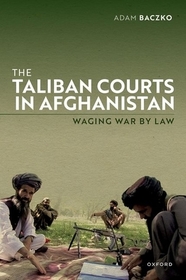
The Taliban Courts in Afghanistan
Waging War by Law
- Publisher's listprice GBP 100.00
-
45 150 Ft (43 000 Ft + 5% VAT)
The price is estimated because at the time of ordering we do not know what conversion rates will apply to HUF / product currency when the book arrives. In case HUF is weaker, the price increases slightly, in case HUF is stronger, the price goes lower slightly.
- Discount 10% (cc. 4 515 Ft off)
- Discounted price 40 635 Ft (38 700 Ft + 5% VAT)
Subcribe now and take benefit of a favourable price.
Subscribe
45 150 Ft

Availability
Estimated delivery time: In stock at the publisher, but not at Prospero's office. Delivery time approx. 3-5 weeks.
Not in stock at Prospero.
Why don't you give exact delivery time?
Delivery time is estimated on our previous experiences. We give estimations only, because we order from outside Hungary, and the delivery time mainly depends on how quickly the publisher supplies the book. Faster or slower deliveries both happen, but we do our best to supply as quickly as possible.
Product details:
- Publisher OUP Oxford
- Date of Publication 17 November 2023
- ISBN 9780198896777
- Binding Hardback
- No. of pages320 pages
- Size 241x160x22 mm
- Weight 604 g
- Language English 438
Categories
Short description:
Informed by the author's extensive fieldwork in Afghanistan, this socio-legal study examines how the Taliban used law and courts to substantiate their claim to embody the state, disseminate their vision of society, and establish local legitimacy.
MoreLong description:
How did the Taliban gain the trust of the Afghan population through decades of conflict? How did they put themselves in a position to regulate social relations? And with what consequences for Afghan society? The Taliban Courts in Afghanistan: Waging War by Law explores how the Taliban used the law as a resource in its conflict with militarily and technologically superior Western armies. While the international coalition set up an inadequate and corrupt legal system, the Taliban set up hundreds of courts in the countryside. By insisting on due process, impartiality of judges, and the enforcement of verdicts, this system of justice established itself as one of the few sources of predictability in the daily lives of Afghans.
The armed movement used law to substantiate their claim to embody the state, disseminate their vision of society, and establish local legitimacy. Their courts attempted to balance the political agenda of the movement, the demands of Islamic law, the needs of the population, and the expectations of international legal actors whose implicit recognition they desired. In contemporary civil wars, where dispensing justice is at once a juridical activity, a political weapon, and a stake in the war, this book thus accounts for why the West lost the war and how the Taliban took over the country.
Based on the author's extensive fieldwork in various provinces in Afghanistan and unique access to Taliban judges and court users, this socio-legal investigation offers new perspectives on a country that was at war for over four decades. Baczko proposes an innovative reflection on the place of law and courts in civil wars as well as a stark reminder of the dangers of foreign intervention. Timely and thought-provoking, this book is appeals to a multi-disciplinary audience including legal scholars, political scientists, sociologists, diplomats, policy-makers, and anyone interested in the Afghan conflict.
It is a well-argued case and fascinating book on an interesting and not well-known country, but the reader may not agree with all the conclusions and arguments made.
Table of Contents:
Introduction: A sociological approach to law in civil wars
Part I: Legal Uncertainty
A revolution in the juridical field
The social upheavals of a war-torn society
Regime justice: Rubberstamping the balance of power
The US Army: Reinventing the tribe, circumventing the courts
Part II: The Taliban Courts
A bureaucratic system
The dual membership of judges
The trials
Part III: Producing a Social Order Through the Law
Judges as an instrument of centralization
Legitimation through law
The society project
Conclusion: The internationalization of law in civil war

