

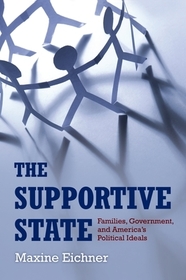
The Supportive State
Families, the State, and American Political Ideals
- Publisher's listprice GBP 37.99
-
17 152 Ft (16 335 Ft + 5% VAT)
The price is estimated because at the time of ordering we do not know what conversion rates will apply to HUF / product currency when the book arrives. In case HUF is weaker, the price increases slightly, in case HUF is stronger, the price goes lower slightly.
- Discount 10% (cc. 1 715 Ft off)
- Discounted price 15 437 Ft (14 702 Ft + 5% VAT)
Subcribe now and take benefit of a favourable price.
Subscribe
17 152 Ft

Availability
printed on demand
Why don't you give exact delivery time?
Delivery time is estimated on our previous experiences. We give estimations only, because we order from outside Hungary, and the delivery time mainly depends on how quickly the publisher supplies the book. Faster or slower deliveries both happen, but we do our best to supply as quickly as possible.
Product details:
- Edition number Reprint
- Publisher OUP USA
- Date of Publication 13 January 2013
- ISBN 9780199935949
- Binding Paperback
- No. of pages210 pages
- Size 231x155x15 mm
- Weight 295 g
- Language English 0
Categories
Short description:
In The Supportive State, Maxine Eichner contends that the family-state relationship must factor into the standard liberal goods of freedom and equality.
MoreLong description:
There is broad agreement among politicians and policymakers that the family is a critical institution of American life. Yet the role that the state should play with respect to family ties among citizens remains deeply contested. This controversy over the state's role undergirds a broad range of public policy debates: Does the state have a responsibility to help resolve conflicts between work and family? Should same-sex marriage be permitted? Should the state encourage marriage and two-parent families? Should parents who receive welfare benefits be required to work? Yet while these individual policy issues are endlessly debated, the underlying theoretical question of the stance that the state should take with families remains largely unexplored.
In The Supportive State: Families, Government, and America's Political Ideals, Maxine Eichner argues that government must take an active role in supporting families. She contends that the respect for human dignity at the root of America's liberal democratic understanding of itself requires that the state not only support individual freedom and equality--the goods generally considered as grounds for state action in liberal accounts. It must also support families, because it is through families that the caretaking and human development needs which must be satisfied in any flourishing society are largely met. Families' capacity to satisfy these needs, she demonstrates, is critically affected by the framework of societal institutions in which they function. In the "supportive state" model she develops, the state bears the responsibility for structuring societal institutions to support families in performing their caretaking and human development functions. Meanwhile, families bear responsibility for the day-to-day caring for (or arranging the care for) family members with dependency needs. In this model, supporting families is as central to the responsibilities of the state as ensuring a competent police force to ensure citizens' safety. Although not all family forms will further the important functions that warrant state support, she argues that a broad range will. Her vigorous defense of the state's responsibility to enhance families' capacity for caretaking and human development stands as a sharp rejoinder to the widespread conservative belief that the state's role in family life must be diminished in order for families to flourish.
The Supportive State rethinks liberal theory from the ground up, incorporating dependence and families rather than pushing them aside. It is a careful, beautifully written renegotiation of the social contract on behalf of real people, rather than the idealized, autonomous-yet-isolated rights-bearers who are the subjects of traditional liberalism. The result is an important contribution both to liberalism and to feminist theory.
Table of Contents:
Introduction
The Family-State Relationship in Contemporary American Theory and Public Policy
Theorizing the Supportive State
The Supportive State and Caretaker-Dependent ("Vertical") Relationships
The Supportive State and ("Horizontal") Relationships Among Adults
Illiberal Families and the Supportive State
Conclusion

