

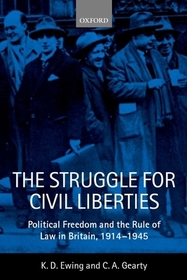
The Struggle for Civil Liberties
Political Freedom and the Rule of Law in Britain, 1914-1945
- Publisher's listprice GBP 55.00
-
24 832 Ft (23 650 Ft + 5% VAT)
The price is estimated because at the time of ordering we do not know what conversion rates will apply to HUF / product currency when the book arrives. In case HUF is weaker, the price increases slightly, in case HUF is stronger, the price goes lower slightly.
- Discount 10% (cc. 2 483 Ft off)
- Discounted price 22 349 Ft (21 285 Ft + 5% VAT)
Subcribe now and take benefit of a favourable price.
Subscribe
24 832 Ft

Availability
printed on demand
Why don't you give exact delivery time?
Delivery time is estimated on our previous experiences. We give estimations only, because we order from outside Hungary, and the delivery time mainly depends on how quickly the publisher supplies the book. Faster or slower deliveries both happen, but we do our best to supply as quickly as possible.
Product details:
- Publisher OUP Oxford
- Date of Publication 16 August 2001
- ISBN 9780198762515
- Binding Paperback
- No. of pages470 pages
- Size 234x156x25 mm
- Weight 710 g
- Language English 0
Categories
Short description:
This book is an account of the struggle for civil liberties against the State in which groups such as the anti-war protestors, the Irish nationalists, the Communist party, trade unionists, and the unemployed workers' movement found themselves involved in the first half of the twentieth century. All had to fight for their civil liberties in the face of strong opposition from the State, including the judges whose attitude to civil liberties was often deeply hostile, and at odds with their supposed role as defenders of freedom.
MoreLong description:
It is widely believed that there is a golden age in which political freedom in Britain was protected by the rule of law, and by judges developing the common law in favour of individual liberty. In an uncompromising and withering account based on a wide range of official and unofficial sources, this path-breaking study by two of the country's leading civil liberties lawyers exposes the mythical nature of much of this traditional learning.
The Struggle for Civil Liberties: Political Freedom and the Rule of law in Britain, 1914-1945 traces the hostile response of the executive and judicial branches of government to the various groups and individuals who confronted the power of the State in the first half of the twentieth century: the wartime peace movements, the Communist Party of Great Britain, the striking trade unionists in 1926, the hunger marches, and the Irish Nationalists. In addressing these issues, the study has a loud contemporary resonance, by placing in a new and alarming historical context the struggles for civil liberties that have been and are being fought by radical groups in contemporary British Society, and during the Thatcher decade in particular.
This book will change forever the way in which open-minded public lawyers think about their subject, and will require a fundamental re-examination of the foundations of the discipline.
By providing the theoretical framework, and a fascinating way to evaluate the issue of the protection of civil liberties in Britain, Ewing and Gearty give the reader a context, a question to ponder while reviewing the wealth of historical evidence that they have compiled. Ultimately, that makes The Struggle for Civil Liberties both interesting and successful as a work of legal history.
Table of Contents:
Introduction
First World War
The Communist Party of Great Britain
The General Strike and its Aftermath
Civil Liberties in the 1930s
The Rise and Fall of Fascism

