

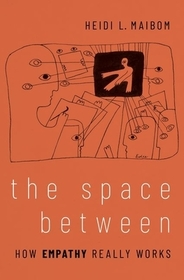
The Space Between
How Empathy Really Works
- Publisher's listprice GBP 29.99
-
13 540 Ft (12 895 Ft + 5% VAT)
The price is estimated because at the time of ordering we do not know what conversion rates will apply to HUF / product currency when the book arrives. In case HUF is weaker, the price increases slightly, in case HUF is stronger, the price goes lower slightly.
- Discount 10% (cc. 1 354 Ft off)
- Discounted price 12 186 Ft (11 606 Ft + 5% VAT)
Subcribe now and take benefit of a favourable price.
Subscribe
13 540 Ft

Availability
Estimated delivery time: In stock at the publisher, but not at Prospero's office. Delivery time approx. 3-5 weeks.
Not in stock at Prospero.
Why don't you give exact delivery time?
Delivery time is estimated on our previous experiences. We give estimations only, because we order from outside Hungary, and the delivery time mainly depends on how quickly the publisher supplies the book. Faster or slower deliveries both happen, but we do our best to supply as quickly as possible.
Product details:
- Publisher OUP USA
- Date of Publication 23 September 2022
- ISBN 9780197637081
- Binding Hardback
- No. of pages320 pages
- Size 216x147x26 mm
- Weight 494 g
- Language English 223
Categories
Short description:
When Barack Obama nominated Sonia Sotomayor to the US Supreme Court, his comments that a judge should have "the heart, the empathy, to recognize what it's like to be a young teenage mom, the empathy to understand what it's like to be poor or African-American or gay, disabled, or old" caused a furor. Objective, reasoned, and impartial judgment were to be replaced by partiality, sentiment, and bias, critics feared. This concern about empathy has since been voiced not just by conservative critics, but by academics and public figures. In The Space Between Heidi Maibom combines results from philosophy, psychology, and neuroscience to show how empathy really works and how, rather than making us biased, it makes us more impartial and more objective.
MoreLong description:
When Barack Obama nominated Sonia Sotomayor to the US Supreme Court, his comments that a judge should have "the heart, the empathy, to recognize what it's like to be a young teenage mom, the empathy to understand what it's like to be poor or African-American or gay, disabled, or old" caused a furor. Objective, reasoned, and impartial judgment were to be replaced by partiality, sentiment, and bias, critics feared. This concern about empathy has since been voiced not just by conservative critics, but by academics and public figures. In The Space Between, Heidi Maibom combines results from philosophy, psychology, and neuroscience to argue that rather than making us more biased or partial, empathy makes us more impartial and more objective.
The problem is that we don't see the world objectively in the first place, Maibom explains. We see it in terms of how we are placed in it: as an extension of our interests, capabilities, and relationships. This is a perspective and it determines what we pay attention to, how we interpret events, and what matters to us individually. It is not private, however. By means of the imagination, Maibom contends, we can place ourselves in another person's web interests, capabilities, and relationships and, viewing the world from there, experience a new way of interpreting and valuing what happens. This broadens and deepens our understanding of others and the world around us. It also helps us understand the greater reality of who we are ourselves.
Maibom's book weaves together results from philosophy, psychology, and neuroscience to provide a positive up-to-date view of what it really means to take another person's perspective, and how empathy, rather than being the enemy of objectivity, is the foundation of it.
The book's audience is interdisciplinary, and the writing is accessible. The text includes useful, sometimes humorous, examples and less jargon than one would expect when philosopher meets social psychologist and lawyer. This argument for empathy in moral decision-making will be welcome in law, philosophy, and social psychology collections.
Table of Contents:
Acknowledgements
Introduction
PART I: PERSPECTIVES: WHAT ARE THEY?
Chapter 1: The Space Between
Chapter 2: What Is a Perspective?
Chapter 3: The Self as Agent, The Self as Observer
Chapter 4: Victims and Perpetrators
Chapter 5: Getting Interpersonal
PART II: HOW TO TAKE ANOTHER POINT OF VIEW
Chapter 6: Perspective Taking
Chapter 7: Knowing You
Chapter 8: Knowing Me
Chapter 9: The Empathy Trap
Chapter 10: Being Impartial
References

