

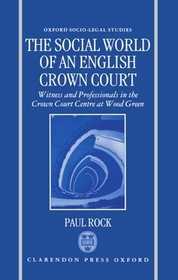
The Social World of an English Crown Court
Witnesses and Professionals in the Crown Court Centre at Wood Green
Series: Oxford Socio-Legal Studies;
- Publisher's listprice GBP 92.00
-
41 538 Ft (39 560 Ft + 5% VAT)
The price is estimated because at the time of ordering we do not know what conversion rates will apply to HUF / product currency when the book arrives. In case HUF is weaker, the price increases slightly, in case HUF is stronger, the price goes lower slightly.
- Discount 10% (cc. 4 154 Ft off)
- Discounted price 37 384 Ft (35 604 Ft + 5% VAT)
Subcribe now and take benefit of a favourable price.
Subscribe
41 538 Ft

Availability
printed on demand
Why don't you give exact delivery time?
Delivery time is estimated on our previous experiences. We give estimations only, because we order from outside Hungary, and the delivery time mainly depends on how quickly the publisher supplies the book. Faster or slower deliveries both happen, but we do our best to supply as quickly as possible.
Product details:
- Publisher Clarendon Press
- Date of Publication 29 July 1993
- ISBN 9780198258438
- Binding Hardback
- No. of pages400 pages
- Size 223x143x27 mm
- Weight 650 g
- Language English
- Illustrations halftones 0
Categories
Short description:
The Social World of an English Crown Court analyses the routine organization of everyday life and work in a middle level metropolitan court. Completing the trilogy begun with A View from the Shadows and Helping Victims of Crime, this new work is unique in British criminology and socio-legal studies and should be essential reading for every serious scholar working in this area.
MoreLong description:
The Social World of an English Crown Court is the first ethnographic study of a Crown Court Centre. It also describes the origins and early history of a pioneering project to support victims and prosecution witnesses appearing before the court–the Witness Support Project.
Paul Rock analyses the major divide which exists in the life of the court between professional insiders and public outsiders. He describes how this divide created problems for witnesses and how the project set out to alleviate this. He provides details of how this division is built into court architecture, administration, and social relations, and examines how it stems from the preoccupation of court officials with the control of knowledge, public order, and emotion.
Excellent ... once I started reading it, I found it compelling ... I found the case study both fascinating and horrific ... a conspicuous example of ethnography at its best.'
Dr P Waddington, University of Reading

