

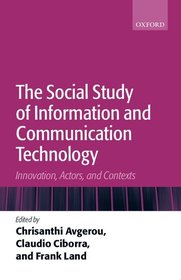
The Social Study of Information and Communication Technology
Innovation, Actors, and Contexts
- Publisher's listprice GBP 59.00
-
26 638 Ft (25 370 Ft + 5% VAT)
The price is estimated because at the time of ordering we do not know what conversion rates will apply to HUF / product currency when the book arrives. In case HUF is weaker, the price increases slightly, in case HUF is stronger, the price goes lower slightly.
- Discount 10% (cc. 2 664 Ft off)
- Discounted price 23 975 Ft (22 833 Ft + 5% VAT)
Subcribe now and take benefit of a favourable price.
Subscribe
26 638 Ft

Availability
printed on demand
Why don't you give exact delivery time?
Delivery time is estimated on our previous experiences. We give estimations only, because we order from outside Hungary, and the delivery time mainly depends on how quickly the publisher supplies the book. Faster or slower deliveries both happen, but we do our best to supply as quickly as possible.
Product details:
- Publisher OUP Oxford
- Date of Publication 17 June 2004
- ISBN 9780199253524
- Binding Paperback
- No. of pages312 pages
- Size 234x157x18 mm
- Weight 482 g
- Language English
- Illustrations numerous tabels and figures 0
Categories
Short description:
As ICTs permeate every sphere of society - business, education, leisure, government, etc. - it is important to reflect the character and complexity of the interaction between people and computers, between society and technology. This book is a useful text for advanced students of MIS and ICT courses, and for those studying ICT in related areas: Management and Organization Studies, Cultural Studies, and Technology and Innovation. It deploys a number of methods such as Actor Network Theory, Socio-Technical Systems, and phenomenological approaches. Management concerns about strategy and productivity are covered together with issues of power, politics, and globalization. Topics range from long-standing themes in the study of IT in organizations such as implementation, strategy, and evaluation, to general analysis of IT as socio-economic change.
MoreLong description:
This book is a useful text for advanced students of MIS and ICT courses, and for those studying ICT in related areas: Management and Organization Studies, Cultural Studies, and Technology and Innovation.
As ICTs permeate every sphere of society - business, education, leisure, government, etc. - it is important to reflect the character and complexity of the interaction between people and computers, between society and technology. For example, the user may represent a much broader set of actors than 'the user' conventionally found in many texts: the operator, the customer, the citizen, the gendered individual, the entrepreneur, the 'poor', the student. Each actor uses ICT in different ways.
This book examines these issues, deploying a number of methods such as Actor Network Theory, Socio-Technical Systems, and phenomenological approaches. Management concerns about strategy and productivity are covered together with issues of power, politics, and globalization. Topics range from long-standing themes in the study of IT in organizations such as implementation, strategy, and evaluation, to general analysis of IT as socio-economic change
A distinguished group of contributors, including Bruno Latour, Saskia Sassen, Robert Galliers, Frank Land, Ian Angel, and Richard Boland, offer the reader a rich set of perspectives and ideas on the relationship between ICT and society, organizational knowledge and innovation.
Table of Contents:
Introduction
Part I: Foundations
Encountering Information Systems as a Phenomenon
Solution is the Problem: A Story of Transitions and Opportunities
On Using ANT for Studying Information Systems: A (Somewhat) Socratic Dialogue
Towards a Sociology of Information Technology
Part II: Theories at Work
Knowledge as Infrastructure
An Ecology of Distributed Practice Involving Knowledge Work
Actor Network Theory and Cultural Aspects of Interpretive Studies
Farewell to Constructivism: Technology and Context-Embedded Action
Framing IS Studies: Understanding the Context of IS Innovation
Part III: Substantive Issues and Applications
Bridging the Digital Divide: New Route to Development or New Form of Dependency
Re-Constructing Information Systems Evaluation
Reflections on Information Systems Strategizing
Socially Self-Destructing Systems

