

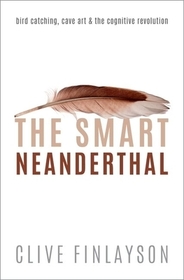
The Smart Neanderthal
Bird catching, Cave Art, and the Cognitive Revolution
- Publisher's listprice GBP 15.49
-
7 400 Ft (7 047 Ft + 5% VAT)
The price is estimated because at the time of ordering we do not know what conversion rates will apply to HUF / product currency when the book arrives. In case HUF is weaker, the price increases slightly, in case HUF is stronger, the price goes lower slightly.
- Discount 10% (cc. 740 Ft off)
- Discounted price 6 659 Ft (6 342 Ft + 5% VAT)
Subcribe now and take benefit of a favourable price.
Subscribe
7 400 Ft

Availability
Estimated delivery time: In stock at the publisher, but not at Prospero's office. Delivery time approx. 3-5 weeks.
Not in stock at Prospero.
Why don't you give exact delivery time?
Delivery time is estimated on our previous experiences. We give estimations only, because we order from outside Hungary, and the delivery time mainly depends on how quickly the publisher supplies the book. Faster or slower deliveries both happen, but we do our best to supply as quickly as possible.
Product details:
- Publisher OUP Oxford
- Date of Publication 12 October 2021
- ISBN 9780198797531
- Binding Paperback
- No. of pages240 pages
- Size 197x130x18 mm
- Weight 224 g
- Language English
- Illustrations 10 black and white images and 4 pp colour plate section 173
Categories
Short description:
Evidence that Neanderthals caught birds and used their feathers for decoration, along with recent discoveries of Neanderthal cave art, are challenging our preconceptions of the cognitive gap between Neanderthals and modern humans. Clive Finlayson draws on new evidence to overturn the old image of the Neanderthal, and our relationship with them.
MoreLong description:
Since the late 1980s the dominant theory of human origins has been that a 'cognitive revolution' (C.50,000 years ago) led to the advent of our species, Homo sapiens. As a result of this revolution our species spread and eventually replaced all existing archaic Homo species, ultimately leading to the superiority of modern humans.
Or so we thought.
As Clive Finlayson explains, the latest advances in genetics prove that there was significant interbreeding between Modern Humans and the Neanderthals. All non-Africans today carry some Neanderthal genes. We have also discovered aspects of Neanderthal behaviour that indicate that they were not cognitively inferior to modern humans, as we once thought, and in fact had their own rituals and art. Finlayson, who is at the forefront of this research, recounts the discoveries of his team, providing evidence that Neanderthals caught birds of prey, and used their feathers for symbolic purposes. There is also evidence that Neanderthals practised other forms of art, as the recently discovered engravings in Gorham's Cave Gibraltar indicate.
Linking all the recent evidence, The Smart Neanderthal casts a new light on the Neanderthals and the "Cognitive Revolution". Finlayson argues that there was no revolution and, instead, modern behaviour arose gradually and independently among different populations of Modern Humans and Neanderthals. Some practices were even adopted by Modern Humans from the Neanderthals. Finlayson overturns classic narratives of human origins, and raises important questions about who we really are.
In this short, engaging book, Finlayson recounts his personal journey to find out about Neanderthals. In doing so, he effectively rattles the bars of the protective cage around our species uniqueness.
Table of Contents:
Preface
Nana and flint
Neanderthals and birds
Lessons from the Arctic
The long-tailed duck
The white ghost
Gibraltar
The dynamic world of dunes
Lakes and plains
The great auk
Big eyes
Digging in the cave
Neanderthal real estate
Of seals and limpets
Birds of a feather
The golden eagle
Ambushing the scavengers
The big six
How to skin a vulture
Pigeons and choughs
Feeding the vultures
The hashtag and the end of the long road to Neanderthal emancipation
Appendix 1 Bird Names used in the Text
Appendix 2 Mammal Names used in the Text
Endnotes
Further reading
Index

