

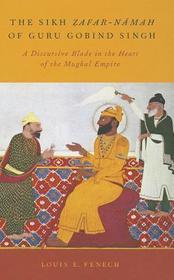
The Sikh Zafar-namah of Guru Gobind Singh
A Discursive Blade in the Heart of the Mughal Empire
- Publisher's listprice GBP 155.00
-
69 982 Ft (66 650 Ft + 5% VAT)
The price is estimated because at the time of ordering we do not know what conversion rates will apply to HUF / product currency when the book arrives. In case HUF is weaker, the price increases slightly, in case HUF is stronger, the price goes lower slightly.
- Discount 10% (cc. 6 998 Ft off)
- Discounted price 62 984 Ft (59 985 Ft + 5% VAT)
Subcribe now and take benefit of a favourable price.
Subscribe
69 982 Ft

Availability
printed on demand
Why don't you give exact delivery time?
Delivery time is estimated on our previous experiences. We give estimations only, because we order from outside Hungary, and the delivery time mainly depends on how quickly the publisher supplies the book. Faster or slower deliveries both happen, but we do our best to supply as quickly as possible.
Product details:
- Publisher OUP USA
- Date of Publication 7 February 2013
- ISBN 9780199931439
- Binding Hardback
- No. of pages336 pages
- Size 160x236x22 mm
- Weight 607 g
- Language English 0
Categories
Short description:
Louis E. Fenech offers a compelling new examination of one of the only Persian compositions attributed to the tenth Sikh Guru, Guru Gobind Singh (1666-1708): the Zafar-namah or 'Epistle of Victory.'
MoreLong description:
Louis E. Fenech offers a compelling new examination of one of the only Persian compositions attributed to the tenth Sikh Guru, Guru Gobind Singh (1666-1708): the Zafar-namah or 'Epistle of Victory.' Written as a masnavi, a Persian poem, this letter was originally sent to the Mughal emperor Aurangzeb (d. 1707) rebuking his most unbecoming conduct. Incredibly, Guru Gobind Singh's letter is included today within the Sikh canon, one of only a very small handful of Persian-language texts granted the status of Sikh scripture. As such, its contents are sung on special Sikh occasions. Perhaps equally surprising is the fact that the letter appears in the tenth Guru's book or the Dasam Granth in the standard Gurmukhi script (in which Punjabi is written) but retains its original Persian language, a vernacular few Sikhs know.
Drawing out the letter's direct and subtle references to the Iranian national epic, the Shah-namah, and to Shaikh Sa'di's thirteenth-century Bustan, Fenech demonstrates how this letter served as a form of Indo-Islamic verbal warfare, ensuring the tenth Guru's moral and symbolic victory over the legendary and powerful Mughal empire. Through analysis of the Zafar-namah, Fenech resurrects an essential and intiguing component of the Sikh tradition: its Islamicate aspect.
The Zafarnama is one of the most fascinating and unusual of early Sikh texts ... French's fine monograph is the first approach to this particularly interesting text to aim to do proper justice, not just to the immediate setting of its contents, but also to the richness of the broader cultural and literary context in which it was produced.
Table of Contents:
Introduction
Chapter 1: Diplomacy at the Court of Guru Gobind Singh
Chapter 2: Zafar-Namah, Fath-Namah, Hikayats, and the Dasam Granth
Chapter 3: The Text of the Zafar-Namah: Guru Gobind Singh, Ferdausi, and Saúdi
Chatper 4: Authorship
Chapter 5: The Sikh Shah-Namah of Guru Gobind Singh
Chapter 6: The Historiography Of The Zafar-namah
Conclusion
Glossary
Bibliography

