

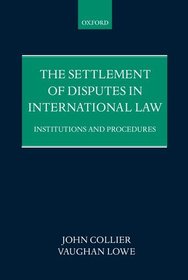
The Settlement of Disputes in International Law
Institutions and Procedures
- Publisher's listprice GBP 297.50
-
134 321 Ft (127 925 Ft + 5% VAT)
The price is estimated because at the time of ordering we do not know what conversion rates will apply to HUF / product currency when the book arrives. In case HUF is weaker, the price increases slightly, in case HUF is stronger, the price goes lower slightly.
- Discount 10% (cc. 13 432 Ft off)
- Discounted price 120 889 Ft (115 133 Ft + 5% VAT)
Subcribe now and take benefit of a favourable price.
Subscribe
134 321 Ft

Availability
printed on demand
Why don't you give exact delivery time?
Delivery time is estimated on our previous experiences. We give estimations only, because we order from outside Hungary, and the delivery time mainly depends on how quickly the publisher supplies the book. Faster or slower deliveries both happen, but we do our best to supply as quickly as possible.
Product details:
- Publisher OUP Oxford
- Date of Publication 7 October 1999
- ISBN 9780198256694
- Binding Hardback
- No. of pages424 pages
- Size 255x178x27 mm
- Weight 861 g
- Language English 0
Categories
Short description:
This book surveys the range of procedures for the settlement of international disputes, whether the disputes arise between States or between States and corporations or individuals. The first part of the book examines non-judicial procedures such as negotiation, mediation, fact-finding, as well as judicial procedures. In the second part of the book the emerging principles of procedural law applied in these tribunals are discussed. Here the authors go through the many and complex stages of the settlement process.
MoreLong description:
For many years it was said that the weakness of international law was the lack of a system for the enforcement of legal obligations. Commentators pointed to the paucity of cases in the International Court and the unwillingness of States to undertake binding obligations to settle their disputes. This position has now changed beyond recognition. The number of international tribunals has increased and many of them, such as ICSID and the International Court of Justice, are busier than at any time in their history. Increasingly, the classical procedures of diplomatic protection are circumvented as corporations and individuals litigate in their own right against States in international tribunals.
This book surveys the range of procedures for the settlement of international disputes, whether the disputes arise between States or between States and corporations or individuals. The first part of the book examines non-judicial procedures such as negotiation, mediation, fact-finding, as well as judicial procedures. Among the tribunals covered are ICSID, the UNCC and the Iran-US Claim Tribunal, the WTO disputes panels, ad-hoc inter-State and international commercial arbitral tribunals and the International Court of Justice. In the second part of the book the emerging principles of procedural law applied in these tribunals are discussed. Here the authors go through the entire settlement process from the agreement to submit to a settlement procedure and the constitution of the tribunal, through to the determination of the law applicable to the merits and to the procedure of the tribunal, to the review, and ultimately the recognition and enforcement of tribunal awards.
"...of value to anyone working and researching in the fields of energy, communications and commercial law" Karen Hulme, Utilities Law Review vol 12 issue 3
Table of Contents:
Preface
Table of Cases
Introduction
PART I: INSTITUTIONS
Methods of settlements of disputes: the basic framework
International Commercial Arbitration
Mixed Arbitrations
Dispute settlement in the Law of the Sea
The settlement of international economic disputes
The International Court of Justice
PART II: PROCEDURE
The Arbitral process
ANNEXES:
Manila Declaration on the Peaceful Settlement of Disputes
Hague Convention on the Pacific Settlement of Disputes, 1907
ICSID Convention
UNCITRAL Arbitration Rules
UNICITRAL Model Law
Statute of the ICJ

