

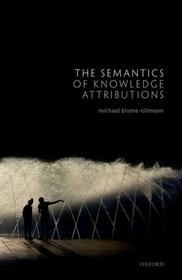
The Semantics of Knowledge Attributions
- Publisher's listprice GBP 89.00
-
40 183 Ft (38 270 Ft + 5% VAT)
The price is estimated because at the time of ordering we do not know what conversion rates will apply to HUF / product currency when the book arrives. In case HUF is weaker, the price increases slightly, in case HUF is stronger, the price goes lower slightly.
- Discount 10% (cc. 4 018 Ft off)
- Discounted price 36 165 Ft (34 443 Ft + 5% VAT)
Subcribe now and take benefit of a favourable price.
Subscribe
40 183 Ft

Availability
Estimated delivery time: In stock at the publisher, but not at Prospero's office. Delivery time approx. 3-5 weeks.
Not in stock at Prospero.
Why don't you give exact delivery time?
Delivery time is estimated on our previous experiences. We give estimations only, because we order from outside Hungary, and the delivery time mainly depends on how quickly the publisher supplies the book. Faster or slower deliveries both happen, but we do our best to supply as quickly as possible.
Product details:
- Publisher OUP Oxford
- Date of Publication 16 June 2022
- ISBN 9780198716303
- Binding Hardback
- No. of pages258 pages
- Size 240x162x18 mm
- Weight 522 g
- Language English 196
Categories
Short description:
This book offers a critical overview of the current debate on the semantics of knowledge attributions. It examines the main principles underlying the various approaches to the topic and outlines how they aim to explain the pertinent data and resolve philosophical puzzles and challenges.
MoreLong description:
In this book, Michael Blome-Tillmann offers a critical overview of the current debate on the semantics of knowledge attributions. The book is divided into five parts. Part 1 introduces the reader to the literature on 'knowledge' attributions by outlining the historical roots of the debate and providing an in-depth discussion of epistemic contextualism. After examining the advantages and disadvantages of the view, Part 2 offers a detailed investigation of epistemic impurism (or pragmatic encroachment views), while Part 3 is devoted to a careful examination of epistemic relativism and Part 4 to two different types of strict invariantism (psychological and pragmatic). The final part of the book explores Presuppositional Epistemic Contextualism - a version of contextualism that is argued to provide a more powerful and elegant account of the semantics of 'knowledge' attributions than many of its competitors. A clear and precise account is provided of the main principles underlying each view and of how they aim to explain the pertinent data and resolve philosophical puzzles and challenges. The book also provides charts outlining the relations between the positions discussed and offers suggestions for further reading.
A very clear, well-structured, informative, and original book about epistemic contextualism... very rich in both scope and ideas... there is no doubt that The Semantics of Knowledge Attributions is a useful tool for those who want to familiarize themselves with the vast literature on 'knowledge'-ascriptions and with the intricate problems that arise in that area, as well as for those steeped in the epistemic debates, urging them to engage with a well-argued for and improved version of epistemic contextualism.
Table of Contents:
Introduction
Part I: Epistemic Contextualism
Epistemic Contextualism
Semantic Implementations
Versions of Contextualism
Linguistic Objections
Philosophical Objections
Part II: Epistemic Impurism
Epistemic Impurism
Problems and Objections
Part III: Epistemic Relativism
Epistemic Relativism
Part IV: Strict Invariantism
Psychological Invariantism
Pragmatic Invariantism
Part V: Presuppositional Epistemic Contextualism
The Presupposition Effect
Presuppositional Epistemic Contextualism
References

