

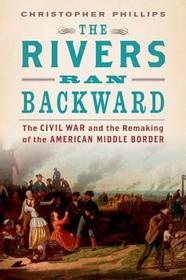
The Rivers Ran Backward
The Civil War and the Remaking of the American Middle Border
- Publisher's listprice GBP 39.99
-
18 055 Ft (17 195 Ft + 5% VAT)
The price is estimated because at the time of ordering we do not know what conversion rates will apply to HUF / product currency when the book arrives. In case HUF is weaker, the price increases slightly, in case HUF is stronger, the price goes lower slightly.
- Discount 10% (cc. 1 806 Ft off)
- Discounted price 16 249 Ft (15 476 Ft + 5% VAT)
Subcribe now and take benefit of a favourable price.
Subscribe
18 055 Ft

Availability
printed on demand
Why don't you give exact delivery time?
Delivery time is estimated on our previous experiences. We give estimations only, because we order from outside Hungary, and the delivery time mainly depends on how quickly the publisher supplies the book. Faster or slower deliveries both happen, but we do our best to supply as quickly as possible.
Product details:
- Publisher OUP USA
- Date of Publication 16 June 2016
- ISBN 9780195187236
- Binding Hardback
- No. of pages528 pages
- Size 163x239x45 mm
- Weight 1046 g
- Language English
- Illustrations 25 illustrations 0
Categories
Short description:
A magnum opus on the history of the middle border states in the Civil War.
MoreLong description:
Most Americans believe that the Ohio River was a clearly defined and static demographic and political boundary between North and South, an extension of the Mason-Dixon Line. Once settled, the new states west of the Appalachians -- the slave states of Kentucky and Missouri and of the free states of Illinois, Indiana, Ohio, and Kansas -- formed a fixed boundary between freedom and slavery, extending the border that inevitably produced the war. None of this is true, except perhaps the outcome of war. But the centrality of the Civil War and its outcome in the making of these tropes is undeniable.
Historian Christopher Phillips contests the assumption that regional identities throughout the "Middle Border" states were stable in the era of the Civil War. States such as Missouri and Kentucky tended to identify as more western than southern during the first half of the nineteenth century. Conversely, much of the population of the lower Midwestern states of Ohio, Illinois, and Indiana had stronger cultural, economic, and political ties to slave states than to New England or the Middle Atlantic. But across the region the Civil War left an indelible imprint on the way in which residents thought of themselves and other Americans, proving as much a shaper as a product of regional identities. A sweeping argument employing a strong narrative, telling vignettes, and the voices of regional and national figures, this book makes a major contribution to Civil War history and to American history on a broader scale.
[A] sprawling account....Phillips' account of the middle border's Civil War is a welcome addition to a historiography of the Civil War that remains in many ways divided into North and South.
Table of Contents:
Prologue "There is a West"
Introduction
Interstice-White Salt, Black Servitude
Chapter One: White Flows the River-Freedom and Unfreedom in the Early National
West
Interstice-North of Slavery, West of Abolition
Chapter Two: Babel-Changed Persistence on Slavery's Borderland
Interstice-Vox Populi
Chapter Three: The Ten Year War-Sectional Politics in a Dividing Region
Interstice-House of Cards
Chapter Four: No North-No South-No East-No West-The Fiction of the
Wartime Middle Ground
Interstice-The Gates of Zion
Chapter Five: Netherworld of War-Civilians, Soldiers, and the Dominion of War
Interstice-War of Another Kind
Chapter Six: Bitter Harvest-Emancipation and the Politics of Loyalty
Interstice-The Art of Retaliation
Chapter Seven: Shadow Wars-The Crucible of Social Violence
Interstice-A River Between Them
Chapter Eight: North Star, Southern Cross-The Politics of Irreconciliation4
Epilogue Rally Round the Flag
Conclusion
Abbreviations
Notes
Bibliography
Acknowledgments
Index

