

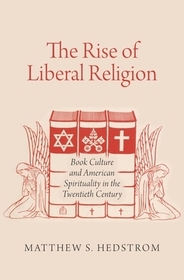
The Rise of Liberal Religion
Book Culture and American Spirituality in the Twentieth Century
- Publisher's listprice GBP 87.00
-
39 280 Ft (37 410 Ft + 5% VAT)
The price is estimated because at the time of ordering we do not know what conversion rates will apply to HUF / product currency when the book arrives. In case HUF is weaker, the price increases slightly, in case HUF is stronger, the price goes lower slightly.
- Discount 15% (cc. 0 Ft off)
- Discounted price 33 388 Ft (31 799 Ft + 5% VAT)
- Discount is valid until: 5 August 2026
Subcribe now and take benefit of a favourable price.
Subscribe
39 280 Ft

Availability
printed on demand
Why don't you give exact delivery time?
Delivery time is estimated on our previous experiences. We give estimations only, because we order from outside Hungary, and the delivery time mainly depends on how quickly the publisher supplies the book. Faster or slower deliveries both happen, but we do our best to supply as quickly as possible.
Product details:
- Publisher OUP USA
- Date of Publication 20 December 2012
- ISBN 9780195374490
- Binding Hardback
- No. of pages288 pages
- Size 163x239x20 mm
- Weight 510 g
- Language English
- Illustrations 17 illustrations 0
Categories
Short description:
In The Rise of Liberal Religion Matthew Hedstrom tells the story of how, beginning in the 1920s, American religious leaders joined forces with the publishing industry in an attempt to form a ''spiritual center''--a set of widely accepted religious ideas, practices, and presuppositions that would hold together a fragmenting society, create new markets for books, and maintain the privileged status of these arbiters in American religious discourse.
MoreLong description:
In The Rise of Liberal Religion Matthew Hedstrom tells the story of how, beginning in the 1920s, American religious leaders joined forces with the publishing industry in an attempt to form a ''spiritual center''--a set of widely accepted religious ideas, practices, and presuppositions that would hold together a fragmenting society, create new markets for books, and maintain the privileged status of these arbiters in American religious discourse. The consensus they sought to form was essentially a liberal Protestant one, but with elements of mysticism and psychology drawn in from the margins. With the coming of World War II, however, political leaders declared "books as weapons in the war of ideas," and the National Conference of Christians and Jews became the central broker of religious reading, coordinating a massive, nationwide Religious Book Week campaign that ran from 1943 to 1948. Spiritual unity was seen not simply as morally desirable for individuals but as essential to national survival. The idea of a religious center expanded to include, however tenuously, Jews and Roman Catholics and the term "Judeo-Christian" entered the national vocabulary. These developments laid the foundation for a culture of spiritual seeking that had lasting implications for middle-class American religious beliefs and practices for the remainder of the twentieth century and into the twenty-first.
This is a useful contribution to the study of American religion in the twentieth century.
Table of Contents:
Introduction
Chapter 1: Enlarging the Faith: Books and the Marketing of Liberal Religion in a Consumer Culture
Chapter 2: The Religious Book Club: Middlebrow Culture and Liberal Protestant Seeker Spirituality
Chapter 3: Publishing for Seekers: Eugene Exman and the Religious Bestsellers of Harper & Brothers
Chapter 4: Religious Reading Mobilized: The Book Programs of World War II
Chapter 5: Inventing Interfaith: The Wartime Reading Campaign of the National Conference of Christians and Jews
Chapter 6: Religious Reading in the Wake of War: American Spirituality in the 1940s
Conclusion
Archival Collections
Notes
Index

