

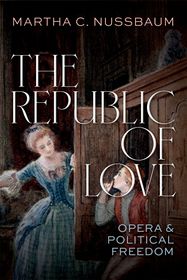
The Republic of Love
Opera and Political Freedom
- Publisher's listprice GBP 22.99
-
10 379 Ft (9 885 Ft + 5% VAT)
The price is estimated because at the time of ordering we do not know what conversion rates will apply to HUF / product currency when the book arrives. In case HUF is weaker, the price increases slightly, in case HUF is stronger, the price goes lower slightly.
- Discount 10% (cc. 1 038 Ft off)
- Discounted price 9 341 Ft (8 897 Ft + 5% VAT)
Subcribe now and take benefit of a favourable price.
Subscribe
10 379 Ft

Availability
Not yet published.
Why don't you give exact delivery time?
Delivery time is estimated on our previous experiences. We give estimations only, because we order from outside Hungary, and the delivery time mainly depends on how quickly the publisher supplies the book. Faster or slower deliveries both happen, but we do our best to supply as quickly as possible.
Product details:
- Publisher OUP USA
- Date of Publication 16 July 2026
- ISBN 9780197812556
- Binding Hardback
- No. of pages392 pages
- Size 211x149x29 mm
- Weight 562 g
- Language English 700
Categories
Short description:
In The Republic of Love, philosopher Martha C. Nussbaum offers a bold and original vision of opera's contribution to political thought. Drawing on her deep knowledge of classical and contemporary opera, she reveals how composers like Mozart, Strauss, Verdi, Beethoven, and others used their music to explore the depths of human emotions and recognize the need for dignity, love, and freedom. Through these works, Nussbaum shows how opera can point the way to a new way of living together.
MoreLong description:
A major work of scholarship by world-renowned, prize-winning philosopher Martha C. Nussbaum, The Republic of Love reveals opera as a profound form of political thought--and an often-overlooked force behind the political reforms of the Enlightenment.
In The Republic of Love, world-renowned philosopher Martha C. Nussbaum offers a bold and original vision of opera's contribution to political thought. Drawing on her deep knowledge of classical and contemporary opera, she reveals how composers such as Mozart, Verdi, Strauss, Beethoven, and others used their music to explore the emotional and ethical dimensions of human life. These works, she argues, illuminate our fundamental need for dignity, love, and freedom in the face of oppressive institutions--and they gesture toward new possibilities for how we might live together.
Nussbaum devotes the first half of her book to Mozart, who embraced a new vision of freedom, writing male characters singing in a new emotional landscape, one that elevated the freedom of others. Her readings of The Marriage of Figaro, Idomeneo, The Magic Flute, Don Giovanni and Cos?? Fan Tutte show an artist who recognized the capacity for love in everyone, and advanced fertile ideas about how we might cultivate it in a new kind of republic. The second half of her book follows this line of thought in operas by Beethoven, Verdi, Benjamin Britten, John Adams, and Jake Heggie, and their greatest antagonist, Richard Wagner, suggesting that they all, in a variety of ways, engage in conversation with Mozart and his themes of love and freedom. Throughout, Nussbaum identifies a recurring operatic metaphor for the impulse toward freedom: the act of breathing itself.
A major work of scholarship by a prize-winning thinker, The Republic of Love redefines opera as a vital, if often overlooked, engine of Enlightenment ideals--and a powerful resource for imagining the emotional foundations of political life.
More than an opera book, more than a philosophy book, Martha C. Nussbaum's The Republic of Love brings new philosophical insights to the world of Mozart, Verdi, and Wagner. Every page sparkles with wisdom, delight, and a genuine love of opera. An extraordinary achievement.
Table of Contents:
Acknowledgments
Introduction
Part One
Chapter 1. Equality and Love at the End of The Marriage of Figaro: Forging Democratic Emotions
Chapter 2. Mozart and the Freemasons: Idomeneo and The Magic Flute
Chapter 3. Two Problem Operas: Don Giovanni and Cos?? Fan Tutte
Chapter 4. "If You Could See This Heart": Mercy in La Clemenza di Tito
Part Two
Chapter 5. Revenge and the Prison: Beethoven's Fidelio, Heggie's Dead Man Walking
Chapter 6. Liberty or the Inquisition?: Authority and Fear in Verdi's Don Carlos
Chapter 7. Internal Exiles: Oppression and Reconciliation in Britten and Jan??cek
Chapter 8. War and the Search for Peace: John Adams's Nixon in China
Chapter 9. Ahasuerus "Redeemed": Wagner from Despair to the Closed Community
Chapter 10. "A Pandemonium as Bright as the Sun and as Crazy as a Madhouse": Verdi's Falstaff

