

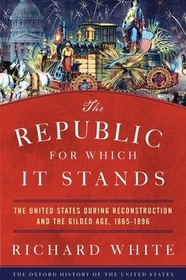
The Republic for Which It Stands
The United States during Reconstruction and the Gilded Age, 1865-1896
Series: Oxford History of the United States;
- Publisher's listprice GBP 21.99
-
9 928 Ft (9 455 Ft + 5% VAT)
The price is estimated because at the time of ordering we do not know what conversion rates will apply to HUF / product currency when the book arrives. In case HUF is weaker, the price increases slightly, in case HUF is stronger, the price goes lower slightly.
- Discount 10% (cc. 993 Ft off)
- Discounted price 8 935 Ft (8 510 Ft + 5% VAT)
Subcribe now and take benefit of a favourable price.
Subscribe
9 928 Ft

Availability
Estimated delivery time: In stock at the publisher, but not at Prospero's office. Delivery time approx. 3-5 weeks.
Not in stock at Prospero.
Why don't you give exact delivery time?
Delivery time is estimated on our previous experiences. We give estimations only, because we order from outside Hungary, and the delivery time mainly depends on how quickly the publisher supplies the book. Faster or slower deliveries both happen, but we do our best to supply as quickly as possible.
Product details:
- Publisher OUP USA
- Date of Publication 14 November 2019
- ISBN 9780190053765
- Binding Paperback
- No. of pages968 pages
- Size 229x155x53 mm
- Weight 1270 g
- Language English
- Illustrations 97 halftone images 0
Categories
Short description:
The newest volume in the Oxford History of the United States series, The Republic for Which It Stands argues that the Gilded Age, along with Reconstruction--its conflicts, rapid and disorienting change, hopes and fears--formed the template of American modernity.
MoreLong description:
The Oxford History of the United States is the most respected multivolume history of the American nation. In the newest volume in the series, The Republic for Which It Stands, acclaimed historian Richard White offers a fresh and integrated interpretation of Reconstruction and the Gilded Age as the seedbed of modern America.
At the end of the Civil War the leaders and citizens of the victorious North envisioned the country's future as a free-labor republic, with a homogenous citizenry, both black and white. The South and West were to be reconstructed in the image of the North. Thirty years later Americans occupied an unimagined world. The unity that the Civil War supposedly secured had proved ephemeral. The country was larger, richer, and more extensive, but also more diverse. Life spans were shorter, and physical well-being had diminished, due to disease and hazardous working conditions. Independent producers had become wage earners. The country was Catholic and Jewish as well as Protestant, and increasingly urban and industrial. The "dangerous" classes of the very rich and poor expanded, and deep differences -- ethnic, racial, religious, economic, and political -- divided society. The corruption that gave the Gilded Age its name was pervasive.
These challenges also brought vigorous efforts to secure economic, moral, and cultural reforms. Real change -- technological, cultural, and political -- proliferated from below more than emerging from political leadership. Americans, mining their own traditions and borrowing ideas, produced creative possibilities for overcoming the crises that threatened their country.
In a work as dramatic and colorful as the era it covers, White narrates the conflicts and paradoxes of these decades of disorienting change and mounting unrest, out of which emerged a modern nation whose characteristics resonate with the present day.
Fearless and peerless, Richard White leads us through a transformed and fragmented nation in turmoil, haunted by the slain Abraham Lincoln, where visions of freedom and equality were rapidly vanishing. In the rural South, in the urban North, and out West, from the terribly destitute to the stupendously wealthy, White brings together stories that historians have long told separately, untangling the anger and blame that grew so deeply entrenched in the Gilded Age. How did all this happen? Richard White explains everything.
Table of Contents:
Maps
Editor's Introduction
Introduction
Part I: Reconstructing the Nation
Prologue: Mourning Lincoln
Chapter One: In the Wake of War
Chapter Two: Radical Reconstruction
Chapter Three: The Greater Reconstruction
Chapter Four: Home
Chapter Five: Gilded Liberals
Chapter Six: Triumph of Wage Labor
Chapter Seven: Panic
Chapter Eight: Beginning a Second Century
Part II: The Quest for Prosperity
Chapter Nine: Years of Violence
Chapter Ten: The Party of Prosperity
Chapter Eleven: People in Motion
Chapter Twelve: Liberal Orthodoxy and Radical Opinions
Chapter Thirteen: Dying for Progress
Chapter Fourteen: The Great Upheaval
Chapter Fifteen: Reform
Chapter Sixteen: Westward the Course of Reform
Chapter Seventeen: The Center Fails to Hold
Chapter Eighteen: The Poetry of a Pound of Steel
Part III: The Crisis Arrives
Chapter Nineteen: The Other Half
Chapter Twenty: Dystopian and Utopian America
Chapter Twenty-one: The Great Depression
Chapter Twenty-two: Things Fall Apart
Chapter Twenty-three: An Era Ends
Conclusion
Bibliographic Essay
Index
Index

