

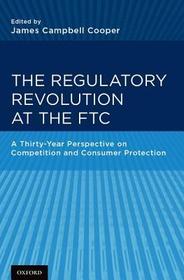
The Regulatory Revolution at the FTC
A Thirty-Year Perspective on Competition and Consumer Protection
- Publisher's listprice GBP 115.00
-
51 922 Ft (49 450 Ft + 5% VAT)
The price is estimated because at the time of ordering we do not know what conversion rates will apply to HUF / product currency when the book arrives. In case HUF is weaker, the price increases slightly, in case HUF is stronger, the price goes lower slightly.
- Discount 10% (cc. 5 192 Ft off)
- Discounted price 46 730 Ft (44 505 Ft + 5% VAT)
Subcribe now and take benefit of a favourable price.
Subscribe
51 922 Ft

Availability
printed on demand
Why don't you give exact delivery time?
Delivery time is estimated on our previous experiences. We give estimations only, because we order from outside Hungary, and the delivery time mainly depends on how quickly the publisher supplies the book. Faster or slower deliveries both happen, but we do our best to supply as quickly as possible.
Product details:
- Publisher OUP USA
- Date of Publication 3 October 2013
- ISBN 9780199989287
- Binding Hardback
- No. of pages208 pages
- Size 160x236x20 mm
- Weight 505 g
- Language English 0
Categories
Short description:
The Regulatory Revolution at the FTC examines a thirty-year period of transition at the Federal Trade Commission, roughly extending from the early 1980s through the present, during which the FTC evolved from an agency on the brink of extinction to one widely respected for its performance and economic sophistication.
MoreLong description:
In the 1970s, the Federal Trade Commission had embarked on an activist consumer protection and antitrust agenda which resulted in severe public and congressional backlash, including calls to abolish the agency. Beginning in 1981, under the direction of Chairman James Miller, the FTC started down a new path of economically-oriented policymaking. This new approach helped save the FTC and laid the groundwork for it to grow into the world-class consumer protection and antritrust agency that it is today.
The Regulatory Revolution at the FTC examines this period of transition in light of continuing debate about the FTC's mission. Editor James Campbell Cooper has assembled contributions from leading economists and scholars, including many of the central figures in the Miller-era Commission and today's FTC, who provide a comprehensive and revealing story about the importance of economic analysis in regulatory decision-making. Together, they foster a crucial understanding of the evolution of the FTC from an agency on the brink of extinction to one widely respected for its performance and economic sophistication.
Table of Contents:
Foreword: James C. Cooper
INTRODUCTION:
PLANTING THE SEEDS OF THE REGULATORY REVOLUTION
Chapter 1: James C. Miller
Causes and Implications of the Regulatory Revolution at the FTC
Chapter 2: Panel Discussion
Politics and Policy in 1981
PART I:
JURISDICTION, POLICY, AND PROCEDURE
Chapter 3: William E. Kovacic
The Federal Trade Commission and the Assignment of Regulatory Tasks
Chapter 4: Julie Brill
The Future of FTC Jurisdiction Over Antitrust and Consumer Protection: A Commentary
Chapter 5: Joshua D. Wright & Angela Diveley
Do Expert Agencies Outperform Generalist Judges? Some Preliminary Evidence from the Federal Trade Commission
Chapter 6: A. Douglas Melamed
Paradigm Shopping: Section 5, the FTC, and the Courts
PART II:
CONSUMER PROTECTION
Chapter 7: Fred S. McChesney
Consumer Protection and James Miller at the Federal Trade Commission
Chapter 8: J. Howard Beales, III, Timothy J. Muris & Robert Pitofsky
In Defense of the Pfizer Factors
Chapter 9: Paul H. Rubin & Thomas M. Lenard
The FTC Then and Now: Privacy
Chapter 10: Paul A. Pautler
Regulation and Behavioral Economics in the Post-Miller FTC
PART III:
ANTITRUST
Chapter 11: Richard S. Higgins & Mark Perelman
Tying to Mitigate the Deadweight Loss of Monopoly Pricing
Chapter 12: Daniel A. Crane
Section 5 and the Innovation Curve
CONCLUSION:
IMPLICATIONS FOR FUTURE FTC ENFORCEMENT
Chapter 13: Panel Discussion
Lessons for Setting Priorities
Index

