

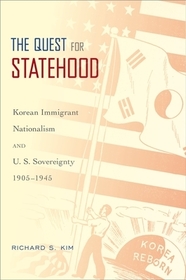
The Quest for Statehood
Korean Immigrant Nationalism and U.S. Sovereignty, 1905-1945
- Publisher's listprice GBP 31.99
-
14 443 Ft (13 755 Ft + 5% VAT)
The price is estimated because at the time of ordering we do not know what conversion rates will apply to HUF / product currency when the book arrives. In case HUF is weaker, the price increases slightly, in case HUF is stronger, the price goes lower slightly.
- Discount 10% (cc. 1 445 Ft off)
- Discounted price 12 998 Ft (12 380 Ft + 5% VAT)
Subcribe now and take benefit of a favourable price.
Subscribe
14 443 Ft

Availability
printed on demand
Why don't you give exact delivery time?
Delivery time is estimated on our previous experiences. We give estimations only, because we order from outside Hungary, and the delivery time mainly depends on how quickly the publisher supplies the book. Faster or slower deliveries both happen, but we do our best to supply as quickly as possible.
Product details:
- Publisher OUP USA
- Date of Publication 8 December 2011
- ISBN 9780195370003
- Binding Paperback
- No. of pages240 pages
- Size 231x155x17 mm
- Weight 318 g
- Language English
- Illustrations 10 hts 0
Categories
Short description:
THE QUEST FOR STATEHOOD explores the efforts of Korean immigrants to fight for the independence of their homeland by participating in civic and political activities in the United States that established them as an American ethnic group.
MoreLong description:
Korean diasporic nationalism in the years between 1905 and 1945 played a foundational role in the emergence of the two separate Koreas after 1945 that both exist to this day. Koreans in the United States were a constitutive part of this historical trajectory. The Quest for Statehood traces the development of Korean immigrant nationalism within the context of the Korean independence movement which sought to liberate Korea from Japanese colonization. Regarding Japanese rule as illegitimate, Koreans in and out of the Korean peninsula viewed themselves as stateless peoples who wanted to establish a sovereign state of their own. Given Japanese repression in Korea, independence activities had to be carried out from abroad, creating conditions for the emergence of a diasporic nationalism. Situated at the nexus of geopolitical relations involving Korea, Japan, and the United States, Koreans in America came to play a vital role in the state-building project of Korean diasporic nationalism. The Quest for Statehood explores the consequences and implications of Korean diasporic identifications with the homeland in a U.S. setting. Due to the constraints of diasporic state-building, U.S.-based Koreans increasingly came to rely on the power of the United States to act as a sovereign state to pursue the national interests of Koreans throughout the diaspora. This study contends this strategic reliance on U.S. state power reflected the development of an ethnic consciousness among Korean immigrants in America. The efforts of Korean immigrants to fight for the independence of their homeland necessitated their participation in civic and political activities in the United States that established them as an American ethnic group. Korean nationalism thus paradoxically led to Korean immigrant incorporation into American political structures whereby ethnicity served as an organizational resource for making nationalist claims in the U.S. political arena. Ultimately, homeland nationalism was central to the assimilation of Korean immigrants as American ethnics.
Richard Kim's excellent book adds to a small but growing number of works to take a disaporic approach to the study of Asian communities in the United States... In taking on this important subject, Kim joins such historians as Madeline Y. Hsu, Adam McKeown, and Eiichiro Azuma in bridging Asian and American Studies, ultimately enriching both fields.
Table of Contents:
Introduction
Mapping the Geopolitical Terrain of the Korean Diaspora
Becoming Diasporic: From Labor Migrants to Exiled Nationalists, 1905-1919
Inaugurating a "New Korea": The March First Movement and the Korean Provisional Government
Contesting Issues of State Power in the Diaspora
Local Struggles and Diasporic Politics: The 1931 Court Cases of the Korean National Association of Hawaii
Kilsoo Haan and "Constructive Americanism": The Ethnicization of Korean Immigrant Nationalism, 1931-1945
"In Due Course": Diasporic Nationalism, the United Korean Committee in America, and U.S. Sovereignty
Conclusion
Notes
Bibliography

