

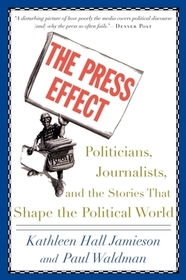
The Press Effect
Politicians, Journalists, and the Stories That Shape the Political World
- Publisher's listprice GBP 18.99
-
8 573 Ft (8 165 Ft + 5% VAT)
The price is estimated because at the time of ordering we do not know what conversion rates will apply to HUF / product currency when the book arrives. In case HUF is weaker, the price increases slightly, in case HUF is stronger, the price goes lower slightly.
- Discount 10% (cc. 857 Ft off)
- Discounted price 7 716 Ft (7 349 Ft + 5% VAT)
Subcribe now and take benefit of a favourable price.
Subscribe
8 573 Ft

Availability
printed on demand
Why don't you give exact delivery time?
Delivery time is estimated on our previous experiences. We give estimations only, because we order from outside Hungary, and the delivery time mainly depends on how quickly the publisher supplies the book. Faster or slower deliveries both happen, but we do our best to supply as quickly as possible.
Product details:
- Publisher OUP USA
- Date of Publication 13 May 2004
- ISBN 9780195173291
- Binding Paperback
- No. of pages240 pages
- Size 205x130x15 mm
- Weight 281 g
- Language English 0
Categories
Long description:
Was the 2000 presidential campaign merely a contest between Pinocchio and Dumbo? And did Dumbo miraculously turn into Abraham Lincoln after the events of September 11? In fact, Kathleen Hall Jamieson and Paul Waldman argue in The Press Effect, these stereotypes, while containing some elements of the truth, represent the failure of the press and the citizenry to engage the most important part of our political process in a critical fashion. Jamieson and Waldman analyze both press coverage and public opinion, using the Annenberg 2000 survey, which interviewed more than 100,000 people, to examine one of the most interesting periods of modern presidential history, from the summer of 2000 through the aftermath of September 11th.
How does the press fail us during presidential elections? Jamieson and Waldman show that when political campaigns side-step or refuse to engage the facts of the opposing side, the press often fails to step into the void with the information citizens require to make sense of the political give-and-take. They look at the stories through which we understand political events--examining a number of fabrications that deceived the public about consequential governmental activities--and explore the ways in which political leaders and reporters select the language through which we talk and think about politics, and the relationship between the rhetoric of campaigns and the reality of governance. They explore the role of the campaigns and the press in casting the 2000 general election as a contest between Pinocchio and Dumbo, and ask whether in 2000 the press applied the same standards of truth-telling to both Bush and Gore. The unprecedented events of election night and the thirty-six days that followed revealed the role that preconceptions play in press interpretation and the importance of press frames in determining the tone of political coverage as well as the impact of network overconfidence in polls.
The Press Effect is, ultimately, a wide-ranging critique of the press's role in mediating between politicians and the citizens they are supposed to serve.
"There is much to be learned from the book's point-by-point analysis and their appeal for higher standards in journalism."-Alexander Stille, New York Times

