

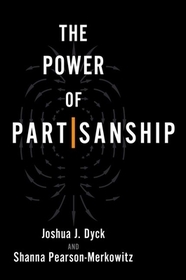
The Power of Partisanship
- Publisher's listprice GBP 68.00
-
30 702 Ft (29 240 Ft + 5% VAT)
The price is estimated because at the time of ordering we do not know what conversion rates will apply to HUF / product currency when the book arrives. In case HUF is weaker, the price increases slightly, in case HUF is stronger, the price goes lower slightly.
- Discount 10% (cc. 3 070 Ft off)
- Discounted price 27 632 Ft (26 316 Ft + 5% VAT)
Subcribe now and take benefit of a favourable price.
Subscribe
30 702 Ft

Availability
printed on demand
Why don't you give exact delivery time?
Delivery time is estimated on our previous experiences. We give estimations only, because we order from outside Hungary, and the delivery time mainly depends on how quickly the publisher supplies the book. Faster or slower deliveries both happen, but we do our best to supply as quickly as possible.
Product details:
- Publisher OUP USA
- Date of Publication 21 November 2023
- ISBN 9780197623787
- Binding Hardback
- No. of pages250 pages
- Size 156x235x18 mm
- Weight 490 g
- Language English 439
Categories
Short description:
In The Power of Partisanship, Joshua J. Dyck and Shanna Pearson-Merkowitz argue that the growth in partisan polarization in the United States, and the resulting negativity voters feel towards their respective opposition party, has far-reaching effects on how Americans behave both inside and outside the realm of politics. Dyck and Pearson-Merkowitz show how partisanship influences the electorate's support for democratic norms, willingness to engage in risk related to financial and healthcare decisions, interracial interactions, and previously non-political decisions like what we like to eat for dinner. Drawing on a series of original surveys and experiments conducted between 2014 and 2020, Dyck and Pearson-Merkowitz show how the dominance of partisanship as a decision cue has fundamentally transformed our understanding of both political and non-political behavior.
MoreLong description:
In The Power of Partisanship, Joshua J. Dyck and Shanna Pearson-Merkowitz argue that the growth in partisan polarization in the United States, and the resulting negativity voters feel towards their respective opposition party, has far-reaching effects on how Americans behave both inside and outside the realm of politics. In fact, no area of social life in the United States is safe from partisan influence. As a result of changes in the media landscape and decades of political polarization, voters are stronger partisans than in the past and are more likely to view the opposition party with a combination of confusion, disdain, and outright hostility. Yet, little of this hostility is grounded in specific policy preferences. Even ideology lacks meaning in the United States: conservative and liberal are what Republicans and Democrats have labeled "conservative" and "liberal."
Dyck and Pearson-Merkowitz show how partisanship influences the electorate's support for democratic norms, willingness to engage in risk related to financial and healthcare decisions, interracial interactions, and previously non-political decisions like what we like to eat for dinner. Partisanship prevents people from learning from their interactions with friends or the realities of their neighborhoods, and even makes them oblivious to their own economic hardship. The intensity and pervasiveness of partisanship in politics today has resulted in "political knowledge" becoming an endogenous feature of strong partisanship and a poor proxy for anything but partisan behavior. Dyck and Pearson-Merkowitz present evidence that pure independents are, in fact, very responsive to information because they are not biased by partisan elite cues and important and relevant political information is often local, contextual, and personal. Drawing on a series of original surveys and experiments conducted between 2014 and 2020, Dyck and Pearson-Merkowitz show how the dominance of partisanship as a decision cue has fundamentally transformed our understanding of both political and non-political behavior.
Dyck and Pearson-Merkowitz conduct a wide-ranging investigation into the effects of partisanship. Drawing on surveys and an array of other data, they show that partisanship and partisan cues shape attitudes, behaviors, and preferences across a huge range of domains, extending well beyond the political realm. This creative and thought-provoking study illuminates the drivers of growing affective polarization in society, as well as the challenges facing American democracy ahead.
Table of Contents:
Introduction
Chapter 1: Partisanship and Ideology in Political Decision-Making
Chapter 2: Elite Cues, Negative Partisanship, and the Changing Media Landscape
Chapter 3: Partisanship, Policy, Compromise, and the Non-political
Chapter 4: Partisanship, Race, and Intergroup Contact
Chapter 5: Prospect Theory and Partisan Cues
Chapter 6: Political Responsiveness to the Lived Experience
Chapter 7: Independents, Knowledge, and Alienation
Chapter 8: An Elite Problem Calls for an Elite Solution
Appendix

