

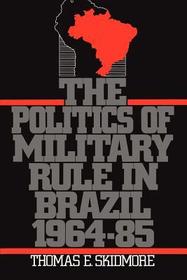
The Politics of Military Rule in Brazil, 1964-1985
- Publisher's listprice GBP 58.00
-
26 187 Ft (24 940 Ft + 5% VAT)
The price is estimated because at the time of ordering we do not know what conversion rates will apply to HUF / product currency when the book arrives. In case HUF is weaker, the price increases slightly, in case HUF is stronger, the price goes lower slightly.
- Discount 10% (cc. 2 619 Ft off)
- Discounted price 23 568 Ft (22 446 Ft + 5% VAT)
Subcribe now and take benefit of a favourable price.
Subscribe
26 187 Ft

Availability
printed on demand
Why don't you give exact delivery time?
Delivery time is estimated on our previous experiences. We give estimations only, because we order from outside Hungary, and the delivery time mainly depends on how quickly the publisher supplies the book. Faster or slower deliveries both happen, but we do our best to supply as quickly as possible.
Product details:
- Publisher OUP USA
- Date of Publication 17 June 1993
- ISBN 9780195063165
- Binding Paperback
- No. of pages432 pages
- Size 219x155x26 mm
- Weight 630 g
- Language English
- Illustrations 1 map 0
Categories
Short description:
In this authoritative study, Thomas E. Skidmore, one of America's leading experts on Latin America and, in particular, on Brazil, offers the first analysis of more than two decades of military rule, from the overthrow of João Goulart in 1964, to the return of democratic civilian government in 1985 with the presidency of José Sarney.
MoreLong description:
The largest and most important country in Latin America, Brazil was the first to succumb to the military coups that struck that region in the 1960s and the early 1970s. In this authoritative study, Thomas E. Skidmore, one of America's leading experts on Latin America and, in particular, on Brazil, offers the first analysis of more than two decades of military rule, from the overthrow of João Goulart in 1964, to the return of democratic civilian government in 1985 with the presidency of José Sarney.
A sequel to Skidmore's highly acclaimed Politics in Brazil, 1930-1964, this volume explores the military rule in depth. Why did the military depose Goulart? What kind of "economic miracle" did their technocrats fashion? Why did General Costa e Silva's attempts to "humanize the Revolution" fail, only to be followed by the most repressive regime of the period? What led Generals Geisel and Golbery to launch the liberalization that led to abertura? What role did the Brazilian Catholic Church, the most innovative in the Americas, play? How did the military government respond in the early 1980s to galloping inflation and an unpayable foreign debt?
Skidmore concludes by examining the early Sarney presidency and the clues it may offer for the future. Will democratic governments be able to meet the demands of urban workers and landless peasants while maintaining economic growth and international competitiveness? Can Brazil at the same time control inflation and service the largest debt in the developing world? Will its political institutions be able to represent effectively an electorate now three times larger than in 1964? What role will the military play in the future?
In recent years, many Third World nations--Argentina, the Philippines, and Uruguay, among others--have moved from repressive military regimes to democratic civilian governments. Skidmore's study provides insight into the nature of this transition in Brazil and what it may tell about the fate of democracy in the Third World.
"Skidmore has written the essential book on contemporary Brazil....Skidmore delivers a remarkably comprehensive, superbly documented, balanced and judicious assessment of Brazil's two decades under military domination."--The Historian

