

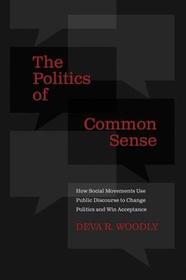
The Politics of Common Sense
How Social Movements Use Public Discourse to Change Politics and Win Acceptance
- Publisher's listprice GBP 41.49
-
19 821 Ft (18 877 Ft + 5% VAT)
The price is estimated because at the time of ordering we do not know what conversion rates will apply to HUF / product currency when the book arrives. In case HUF is weaker, the price increases slightly, in case HUF is stronger, the price goes lower slightly.
- Discount 10% (cc. 1 982 Ft off)
- Discounted price 17 839 Ft (16 989 Ft + 5% VAT)
Subcribe now and take benefit of a favourable price.
Subscribe
19 821 Ft

Availability
printed on demand
Why don't you give exact delivery time?
Delivery time is estimated on our previous experiences. We give estimations only, because we order from outside Hungary, and the delivery time mainly depends on how quickly the publisher supplies the book. Faster or slower deliveries both happen, but we do our best to supply as quickly as possible.
Product details:
- Publisher OUP USA
- Date of Publication 25 June 2015
- ISBN 9780190203993
- Binding Paperback
- No. of pages272 pages
- Size 231x152x20 mm
- Weight 363 g
- Language English 0
Categories
Short description:
The way that movements communicate with the general public matters for their chances of lasting success. Comparing the public discourse on the living wage and marriage equality between 1994 and 2004, Deva Woodly shows that movement-led political change is rooted in whether or not movements are able to gain political acceptance.
MoreLong description:
The way that movements communicate with the general public matters for their chances of lasting success. Devo Woodly argue that the potential for movement-led political change is significantly rooted in mainstream democratic discourse and specifically in the political acceptance of new issues by news media, the general public, and elected officials. This is true to some extent for any group wishing to alter status quo distributions of rights and/or resources, but is especially important for grassroots challengers who do not already have a place of legitimated influence in the polity. By examining the talk of two contemporary movements, the living wage and marriage equality, during the critical decade after their emergence between 1994-2004, Woodly shows that while the living wage movement experienced over 120 policy victories and the marriage equality movement suffered many policy defeats, the overall impact that marriage equality had on changing American politics was much greater than that of the living wage because of its deliberate effort to change mainstream political discourse, and thus, the public understanding of the politics surrounding the issue.
MoreTable of Contents:
Introduction: The Discursive Power of Movements
Chapter One: Mainstream Discourse, Public Meaning, and the Political Character of Persuasion
Chapter Two: A Tale of Two Movements- Living Wage
Chapter Three: A Tale of Two Movements- Marriage Equality
Chapter Four: The Discursive Architecture of Resonance
Chapter Five: Political Acceptance and the Process of Political Change
Chapter Six: From Marginal to Mainstream
Conclusion: After Acceptance - the Tea Party, Occupy & Prospects for political transformation
Appendix A
Appendix B
Bibliography

