

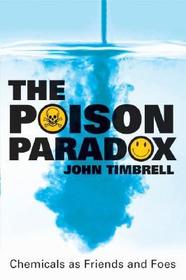
The Poison Paradox
Chemicals as Friends and Foes
- Publisher's listprice GBP 22.00
-
10 510 Ft (10 010 Ft + 5% VAT)
The price is estimated because at the time of ordering we do not know what conversion rates will apply to HUF / product currency when the book arrives. In case HUF is weaker, the price increases slightly, in case HUF is stronger, the price goes lower slightly.
- Discount 10% (cc. 1 051 Ft off)
- Discounted price 9 459 Ft (9 009 Ft + 5% VAT)
Subcribe now and take benefit of a favourable price.
Subscribe
10 510 Ft

Availability
Out of print
Why don't you give exact delivery time?
Delivery time is estimated on our previous experiences. We give estimations only, because we order from outside Hungary, and the delivery time mainly depends on how quickly the publisher supplies the book. Faster or slower deliveries both happen, but we do our best to supply as quickly as possible.
Product details:
- Publisher Oxford University Press
- Date of Publication 23 June 2005
- ISBN 9780192804952
- Binding Hardback
- No. of pages352 pages
- Size 242x163x24 mm
- Weight 696 g
- Language English
- Illustrations numerous b/w line, halftones, b/w plates 0
Categories
Short description:
This is a fascinating and informed work that illuminates the world of toxicology. Using reported disasters and everyday examples, the author examines both natural and man-made chemicals that we are exposed to. He explains how they are toxic and the different reactions that individuals have to them. He debunks the popular belief that 'Natural is good, Man-made is bad' and quantifies the real risks.
MoreLong description:
Every day we are surrounded by chemicals that are potentially harmful. Some of these we take intentionally in the form of drugs; some we take unknowingly through the food we eat, and the environment around us.
John Timbrell explores what makes particular chemicals harmful, what their effects are, and how we can test for them. He examines drugs such as Paracetamol and what it does to the body; Ricin, the most toxic substance known to man; Paraquat, a widely available weedkiller; and how the puffer fish, eaten as a delicacy in Japan, can kill. Using case studies from all around the world, such as the Spanish Oil syndrome which made over 20,000 people ill in Madrid, Timbrell uncovers the facts behind
chemical scares. He shows how, with a rational, scientific, and balanced approach, risks can be assessed and managed safely.
Compelling... Skip your high-production-value crime drama on the television tonight, and spend the evening with the Poison Paradox. I doubt you will read every page, but I think you might enjoy those that you do.
Table of Contents:
Old art, new science: Introduction to toxicology
What chemicals do to us and what our bodies do to them: The principles of toxicology
Keep taking the medicine, "But is it safe Doctor?": chemicals we deliberately swallow
Blood, sweat, and tears: Pesticides, poisons man has designed
First the cats died: Environmental contaminants
Natural born killers: Chemicals nature designs to be poisonous
The Mad Hatter and a bad case of acne: Industrial chemicals
Under the sink and in the shed: Household poisons
Rasputin's revenge: Chemicals used to kill
Ginger Jake and Spanish oil: Food contaminants and additives
A risky business: The assessment of risk from chemicals
Glossary
Bibliography
Index

