

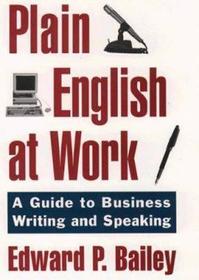
The Plain English Approach to Business Writing
- Publisher's listprice GBP 19.49
-
9 311 Ft (8 867 Ft + 5% VAT)
The price is estimated because at the time of ordering we do not know what conversion rates will apply to HUF / product currency when the book arrives. In case HUF is weaker, the price increases slightly, in case HUF is stronger, the price goes lower slightly.
- Discount 10% (cc. 931 Ft off)
- Discounted price 8 379 Ft (7 980 Ft + 5% VAT)
Subcribe now and take benefit of a favourable price.
Subscribe
9 311 Ft

Availability
printed on demand
Why don't you give exact delivery time?
Delivery time is estimated on our previous experiences. We give estimations only, because we order from outside Hungary, and the delivery time mainly depends on how quickly the publisher supplies the book. Faster or slower deliveries both happen, but we do our best to supply as quickly as possible.
Product details:
- Edition number New ed, Revised
- Publisher OUP USA
- Date of Publication 20 November 1997
- ISBN 9780195115659
- Binding Paperback
- No. of pages144 pages
- Size 213x137x12 mm
- Weight 181 g
- Language English 0
Categories
Short description:
Written for busy professionals who want to improve the quality and clarity of their own (or their staff's) writing style, this is an essential guide for anyone who has ever fallen prey to businessese, academese, legalese, or any other `ese' when faced with a blank memo pad.
Pithy and entertaining, Bailey points out all the dos and don'ts of plain English. He then illustrates them with examples drawn from a wide array of sources, including business documents, technical manuals, trade publications, and the works of writers such as Russell Baker and John D. MacDonald. From the basics to the fine tuning, he offers practical advice on clarity and precision, organization, layout, and a host of other important writing topics.
Long description:
In offices across America, the Masters of Gobbledygook are hard at work. They're bombarding in-boxes with those long, confusing memos that colleagues don't have the patience to read--and bosses don't have the time to rewrite. They use words like "commence" or "prior to" instead of "begin" or "before." They bury their main point somewhere in the last paragraph--and take two pages to get there. Everybody knows one of them; in fact, you may even be one of them. But now there's help for anyone who's ever fallen prey to businessese, academese, legalese, or any other "ese" when faced with a blank memo pad.
In The Plain English Approach to Business Writing, Edward Bailey--who spent twenty years working in the bastions of bureaucratese--offers readers a powerful new communications tool. Written for busy professionals who want to improve the quality and clarity of their own (or their staff's) writing style, this no-nonsense guide is an indispensable office companion. Bailey's approach is surprisingly straightforward: just write as you would talk. Plain English is not only easier to read; it's also easier to write. And it's so effective that many large organizations are endorsing, if not demanding, its use in the work place. Pithy and entertaining, Bailey points out all the dos and don'ts of plain English. He then illustrates them with examples drawn from a wide array of sources, including business documents, technical manuals, trade publications like Consumer Reports, and the works of writers such as Russell Baker and John D. MacDonald. From the basics to the fine tuning, he offers practical advice on clarity and precision, organization, layout, and a host of other important writing topics.
A delightful, down-to-earth guide, The Plain English Approach to Business Writing is for professionals of all backgrounds (government, military, legal, financial, technical, corporate) and staff at all levels (from the company CEO to the ambitious secretary). The Plain English Approach to Business Writing can be read in an hour--and used for the rest of one's life.

