

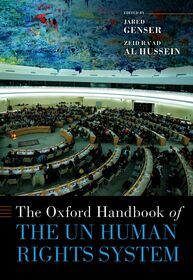
The Oxford Handbook of the UN Human Rights System
Series: Oxford Handbooks;
- Publisher's listprice GBP 205.00
-
92 557 Ft (88 150 Ft + 5% VAT)
The price is estimated because at the time of ordering we do not know what conversion rates will apply to HUF / product currency when the book arrives. In case HUF is weaker, the price increases slightly, in case HUF is stronger, the price goes lower slightly.
- Discount 10% (cc. 9 256 Ft off)
- Discounted price 83 302 Ft (79 335 Ft + 5% VAT)
Subcribe now and take benefit of a favourable price.
Subscribe
92 557 Ft

Availability
Not yet published.
Why don't you give exact delivery time?
Delivery time is estimated on our previous experiences. We give estimations only, because we order from outside Hungary, and the delivery time mainly depends on how quickly the publisher supplies the book. Faster or slower deliveries both happen, but we do our best to supply as quickly as possible.
Product details:
- Publisher OUP USA
- Date of Publication 9 September 2026
- ISBN 9780197599945
- Binding Hardback
- No. of pages1304 pages
- Size 254x180x61 mm
- Weight 2227 g
- Language English 0
Categories
Short description:
The Oxford Handbook of the UN Human Rights System is the first comprehensive and compelling practical account of the human rights work carried out by the United Nations. It explains the various parts of the system, describes the functions, strengths, and weaknesses of each key body, and examines how each of the individual parts of this system and the broader system can be improved to deliver results for the peoples of the world. This book examines these questions over time, looking back at the historical engagement of each UN body with human rights, reviewing what each body is doing now and what it has achieved, and proposing targeted suggestions for reform. Importantly, each chapter is authored by either current or former diplomats who have led each part of the system or by expert practitioners and academics. Taken together, this Handbook provides a truly unique and first-ever view of both the entire system and its individual parts as they are today and how they can be harnessed going forward for greater impact.
MoreLong description:
Human rights have been embedded in the work of the United Nations since its creation. The very purpose of the United Nations, set forth in the UN Charter, is to "reaffirm faith in fundamental human rights" and "encourag[e] respect for human rights and for fundamental freedoms." Creating an efficient and effective machinery to do so, however, has been a persistent challenge. Not only are the human rights functions of the United Nations carried out by the UN High Commissioner for Human Rights and an array of bodies, agencies, experts, and mechanisms. But the Office of the UN High Commissioner for Human Rights, which is supposed to drive the core human rights work of the United Nations, receives only some $200 million annually, less than four percent of the UN's regular budget.
The Oxford Handbook of the UN Human Rights System is the first comprehensive and compelling practical account of the human rights work carried out by the United Nations. It explains the various parts of the system, describes the functions, strengths, and weaknesses of each key body, and examines how each of the individual parts of this system and the broader system can be improved to deliver results for the peoples of the world. This book examines these questions over time, looking back at the historical engagement of each UN body with human rights, reviewing what each body is doing now and what it has achieved, and proposing practical and targeted suggestions for reform. Importantly, each chapter is authored by either current or former diplomats who have led each part of the system or by expert practitioners. Taken together, this Oxford Handbook provides a truly unique and first-ever view of the both entire system and its individual parts as they are today and how they can be harnessed going forward for greater impact.
Table of Contents:
Part I. History of the UN Human Rights System
The UN Charter and International Human Rights Law
The Universal Declaration of Human Rights
Part II. The UN Charter-Based System
The UN Commission on Human Rights
The UN Human Rights Council
UN Special Rapporteurs and Independent Experts
UN Working Groups
The Universal Periodic Review
UN Commissions of Inquiry, Fact-Finding Missions, and Other Investigations
Sexual Orientation and Gender Identity
Politics and Politicization at the Human Rights Council
Knowing the Difference-A Critique of the UN's Role in Advancing Human Rights
The UN Commission on the Status of Women
The UN General Assembly and Human Rights
The UN Security Council and Human Rights
Part III. The UN Treaty-Based System
UN Treaty Body Strengthening, Coordination, and Reform
The Human Rights Committee
The Committee on Economic, Social, and Cultural Rights
The Committee on the Elimination of Racial Discrimination
Committee on the Elimination of Discrimination Against Women
The Committee on the Rights of the Child
The Committee Against Torture
The Subcommittee on Prevention of Torture and Other Cruel, Inhuman, or Degrading Treatment or Punishment
The Committee on Migrant Workers
The Committee on Enforced Disappearances
The Committee on the Rights of Persons with Disabilities
The Rights of Persons with Disabilities in the Broader UN System
Part IV. The UN High Commissioner for Human Rights
The Office of the UN High Commissioner for Human Rights
Privilege No One
Impartial Judge, Unwavering Advocate
A Voice for Victims
Part V. The UN Secretary-General and Cross-System Coordination
Coordination and Mainstreaming: Integrating Human Rights in the Work of the UN System
Human Rights Up Front-A Return to Charter Values
The Highest Aspiration: A Call to Action for Human Rights
Part VI. UN Special Advisers, Special Envoys, and Special Representatives of the UN Secretary-General
The UN Special Adviser on the Prevention of Genocide and the UN Special Adviser on the Responsibility to Protect
The Special Envoy for Global Education
Business and Human Rights
The UN Special Representative of the Secretary-General on Sexual Violence in Conflict
The UN Special Representative of the Secretary-General for Children and Armed Conflict
The UN Special Representative of the Secretary-General on Violence Against Children
Part VII. Engagement by Civil Society Organizations
Civil Society and the UN Human Rights System
Part VIII. Emerging Challenges to the UN Human Rights System
Climate Change and Human Rights
Artificial Intelligence and Human Rights
COVID-19, Pandemics, and Human Rights

