

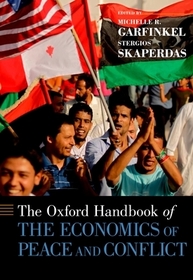
The Oxford Handbook of the Economics of Peace and Conflict
Series: Oxford Handbooks;
- Publisher's listprice GBP 195.00
-
88 042 Ft (83 850 Ft + 5% VAT)
The price is estimated because at the time of ordering we do not know what conversion rates will apply to HUF / product currency when the book arrives. In case HUF is weaker, the price increases slightly, in case HUF is stronger, the price goes lower slightly.
- Discount 10% (cc. 8 804 Ft off)
- Discounted price 79 238 Ft (75 465 Ft + 5% VAT)
Subcribe now and take benefit of a favourable price.
Subscribe
88 042 Ft

Availability
printed on demand
Why don't you give exact delivery time?
Delivery time is estimated on our previous experiences. We give estimations only, because we order from outside Hungary, and the delivery time mainly depends on how quickly the publisher supplies the book. Faster or slower deliveries both happen, but we do our best to supply as quickly as possible.
Product details:
- Publisher OUP USA
- Date of Publication 24 May 2012
- ISBN 9780195392777
- Binding Hardback
- No. of pages888 pages
- Size 185x251x50 mm
- Weight 1721 g
- Language English
- Illustrations 32 illustrations 0
Categories
Short description:
This Handbook brings together contributions from leading scholars who take an economic perspective to study peace and conflict. Some chapters are largely empirical, exploring the correlates and quantifying the costs of conflict. Others are more theoretical, examining the mechanisms that lead to war or are more conducive to peace.
MoreLong description:
Social scientists and policy makers have long been interested in the causes and consequences of peace and conflict. This handbook brings together contributions from leading scholars who take an economic perspective to study the topic. It includes thirty-three chapters and is divided into five parts: Correlates of Peace and Conflict; Consequences and Costs of Conflict; On the Mechanics of Conflict; Conflict and Peace in Economic Context; and Pathways to Peace. Taken together, they demonstrate not only how the tools of economics can be fruitfully used to advance our understanding of conflict, but how explicitly incorporating conflict into economic analysis can add substantively to our understanding of observed economic phenomena. Some chapters are largely empirical, identifying correlates of war and peace and quantifying many of the costs of conflict. Others are more theoretical, exploring a variety of mechanisms that lead to war or are more conducive to peace.
Garfinkel and Skaperdas have provided a major service to the community of researchers working on the economics and analytics of conflict. The breadth of coverage of the volume is unparalleled and quality of the contributions is remarkably high.
Table of Contents:
I Introduction
1. Economic perspectives on peace and conflict.
Michelle R. Garfinkel and Stergios Skaperdas
II Correlates of peace and conflict
2. Informational aspects of conflict.
Karl Wärneryd
3. Commitment problems and shifting power as a cause of conflict.
Robert Powell
4. Bargaining and conflict with incomplete information.
Santiago Sanchez-Pages
5. The Hobbesian trap.
Sandeep Baliga and Tomas Sjöström
6. Religion, conflict and cooperation.
Michael T. McBride and Gary Richardson
7. Comparing polarization measures.
Joan Esteban and Debraj Ray
8. Inequality, polarization and conflict.
Jose G. Montalvo and Marta Reynal-Querol
9. On the causes of civil war.
Anke Hoeffler
10. Reflections on Africa's wars.
Jean-Paul Azam
III Consequences and costs of conflict
11. Methods for measuring aggregate costs of conflict.
Javier Gardeazabal
12. How many bucks in a bang: On the estimation of the economic costs of conflict.
Tilman Brück, Olaf J. de Groot and Carlos Bozzoli
13. Estimating the costs of war: Methodological issues, with applications to Iraq and
Afghanistan.
Joseph E. Stiglitz and Linda J. Bilmes
14. Estimating the human costs of war: A sample survey approach.
Michael Spagat
15. Mental health in the aftermath of conflict.
Quy-Toan Do and Lakshmi Iyer
16. Measuring the economic costs of terrorism.
Walter Enders and Eric Olson
17. Assessing the e_ects of military expenditure on growth.
Giorgio d'Agostino, J. Paul Dunne, and Luca Pieroni
18. The economic welfare cost of conflict: An empirical assessment.
S. Brock Blomberg and Gregory D. Hess
IV On the mechanics of conflict
19. Technologies of conflict.
Hao Jia and Stergios Skaperdas
20. Endogenous formation of alliances in contests.
Francis Bloch
21. Conflict with multiple battlefields.
Dan Kovenock and Brian Roberson
22. Laboratory experiments on conflict.
Klaus Abbink
V Conflict and peace in economic context
23. War, trade, and natural resources: A historical perspective.
Ronald Findlay and Kevin O'Rourke
24. Trade in the shadow of power.
Michelle R. Garfinkel, Stergios Skaperdas, and Constantinos Syropoulos
25. Conflict and policy in general equilibrium: Insights from a standard trade model.
Ernesto Dal Bó and Pedro Dal Bó
26. The use of coercion in society: insecure property rights, conflict and economic backwardness.
Francisco M. Gonzalez
27. War and poverty.
Patricia Justino
28. Aggressive elites and vulnerable entrepreneurs: Trust and cooperation in the shadow
of conflict.
Halvor Mehlum and Karl Moene
VI Pathways to peace
29. Globalization and international conflict: Can FDI increase cooperation among nations?
Solomon W. Polachek, Carlos Seiglie, and Jun Xiang
30. National borders, conflict and peace.
Enrico Spolaore
31. Political institutions and war initiation: The democratic peace hypothesis revisited.
Michelle R. Garfinkel
32. Why follow the leader? Collective action, credible commitment and conflict.
Philip Keefer
33. Conflict -inhibiting norms.
Peter T. Leeson and Christopher J. Coyne

