

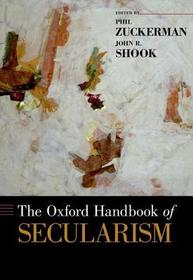
The Oxford Handbook of Secularism
Series: Oxford Handbooks;
- Publisher's listprice GBP 167.50
-
75 626 Ft (72 025 Ft + 5% VAT)
The price is estimated because at the time of ordering we do not know what conversion rates will apply to HUF / product currency when the book arrives. In case HUF is weaker, the price increases slightly, in case HUF is stronger, the price goes lower slightly.
- Discount 10% (cc. 7 562 Ft off)
- Discounted price 68 064 Ft (64 823 Ft + 5% VAT)
Subcribe now and take benefit of a favourable price.
Subscribe
75 626 Ft

Availability
printed on demand
Why don't you give exact delivery time?
Delivery time is estimated on our previous experiences. We give estimations only, because we order from outside Hungary, and the delivery time mainly depends on how quickly the publisher supplies the book. Faster or slower deliveries both happen, but we do our best to supply as quickly as possible.
Product details:
- Publisher OUP USA
- Date of Publication 23 February 2017
- ISBN 9780199988457
- Binding Hardback
- No. of pages794 pages
- Size 251x175x48 mm
- Weight 1451 g
- Language English 0
Categories
Short description:
The Oxford Handbook of Secularism offers a wide-ranging examination of secularism on a global scale, bringing together an international collection of views from prominent experts in a variety of fields. This volume reflects the impressive level of academic attention now given to secularism across the humanities, social sciences, law and public policy, and international relations.
MoreLong description:
As recent headlines reveal, conflicts and debates around the world more and more frequently involve secularism. National borders and traditional religions can no longer keep people in tidy boxes anymore as political struggles, doctrinal divergences, and demographic trends sweep across regions and entire continents. Secularity is increasing in society, with a growing number of people in many regions having no religious affiliation or lacking interest in religion. Simultaneously, there is a resurgence of religious participation in the politics of many countries. How might these diverse phenomena be interrelated, and better understood?
The Oxford Handbook of Secularism offers a wide-ranging examination of secularism on a global scale, bringing together an international collection of views from prominent experts in a variety of fields. This volume reflects the impressive level of academic attention now given to secularism across the humanities, social sciences, law and public policy, and international relations. Long-reigning theories about the pace of secularization, and ideal church-state relations, are here scrutinized by a new generation of scholars studying secularism with new questions, better data, and fresh perspectives.
This is the essential volume for comprehending the core issues and methodological approaches to the demographics and sociology of secularity; the history and variety of political secularisms; the comparison of constitutional secularisms across countries spanning from America to Asia; the key problems now convulsing church-state relations; the intersections of liberalism, multiculturalism, and religion; the latest psychological research into secular lives and lifestyles; and the naturalistic and humanistic worldviews available to nonreligious people. The Oxford Handbook of Secularism addresses a wide breadth of interrelated issues and problems from multi-disciplinary stances, covering scholarly territory not addressed previously.
Throughout the text, the myriad contributors offer observations and analysis on the ethics, effects, and challenges of secularism. These threads weave throughout the extensive and diverse range of topics, pulling them together into a surprisingly cohesive set of commentaries. The result is not a book without fault, but one whose collective merits far outweigh any particular gripes. The final point in favor of the text is its forty-three page index. Exhaustive and well-organized, it provides the necessary mechanism for navigating a handbook of this size and scope. This text is an essential reference book
Table of Contents:
Contributors
Introduction: The Study of Secularism
Phil Zuckerman and John R. Shook
Part One: Identifying the Secular, Secularity, Secularization, and Secularism
1. Identifying (with) the Secular
Johannes Quack
2. Religious/Non-Religious Demography and Religion v. Science: A Global Perspective
Ariela Keysar
3. Secularization and its Consequences
Steve Bruce
4. The Imagined War between Secularism and Religion
Mark Juergensmeyer
5. Political Secularism
Jacques Berlinerblau
6. Political Secularism and Democracy in Theory and Practice
Jonathan Fox
Part Two: Secular Governments
7. Anglo-American Secular Government
John Perry
8. Secularism in France
Amélie Barras
9. Secularism in Turkey
Kenan Sevinc, Ralph W. Hood Jr., Thomas Coleman
10. Secularization in Israel
Guy Ben-Porat
11. Secularism, State Neutrality, and Islam
Abdullah Saeed
12. Secular Government in sub-Saharan Africa
Baffour K. Takyi
13. Secularism in India
Vidhu Verma
14. Soviet Atheism and its Aftermath
Sonja Luehrmann
15. Sacred, Secular, and Neo-sacred Governments in China and Taiwan
Cheng-tian Kuo
Part Three: Contesting Political Secularism
16. Religion in the Public Sphere
Cristina Lafont
17. The Liberal Betrayal of Secularism
Shadia B. Drury
18. Religious Freedom in a Secular Society
Roger Trigg
19. Communicative Reason and Religious Faith in Secular and Post-Secular Contexts
Jacob Goodson
20. Secularisms or Liberal-Democratic Constitutionalism
Veit Bader
21. Multiculturalizing Secularism
Tariq Modood
22. Secularisms or Critique of Religio-Secularism
Yolande Jansen
Part Four: Politics of Church and State
23. A Secular Critique of Religious Ethics and Politics
Paul Cliteur
24. Secular Education and Religion
James Arthur
25. Secularism, Feminism and the Public Sphere
Niamh Reilly
26. Secularism, Race, and Political Affiliation in America
Juhem Navarro-Rivera and Yazmín García Trejo
27. Black Infidels
Sikivu Hutchinson
28. Secularism and U.S. Religion Jurisprudence
Caroline Corbin
29. Separating Church and State in America
David Niose
Part Five: Secularity and Society
30. Varieties of Secular Experience
David Eller
31. Secular Living
Jesse Smith
32. Secular Prosociality and Well-being
Luke Galen
33. Secularism and the Science of Well-being
David Yaden, Jonathan Iwry, Emily Esfahani Smith, James Pawelski
34. Secular Spirituality
Robert C. Fuller
35. Nonreligious People in Religious Societies
Will Gervais and Maxine Najle
36. The Challenge of Leaving Religion and Becoming Secular
Marlene Winell
Part Six: Morality and Secular Ethics
37. Agency and Responsibility in a Natural World
Erik Wielenberg
38. The Evolution of Sociality, Helping and Morality
Dennis Krebs and Kaleda Denton
39. Ethics, Secular and Religious
John Teehan
40. Secular Ethics, East and West
Sor-hoon Tan
41. Secularism, Humanism, and Secular Humanism
Joseph Blankholm
42. Humanism as a Positive Outcome of Secularism
Joachim Duyndam
43. Secularization, Bio-medical Technology and Life Extension
Brian S. Turner
Index

