

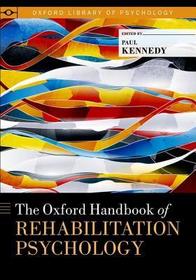
The Oxford Handbook of Rehabilitation Psychology
Series: Oxford Library of Psychology;
- Publisher's listprice GBP 167.50
-
75 626 Ft (72 025 Ft + 5% VAT)
The price is estimated because at the time of ordering we do not know what conversion rates will apply to HUF / product currency when the book arrives. In case HUF is weaker, the price increases slightly, in case HUF is stronger, the price goes lower slightly.
- Discount 10% (cc. 7 562 Ft off)
- Discounted price 68 064 Ft (64 823 Ft + 5% VAT)
Subcribe now and take benefit of a favourable price.
Subscribe
75 626 Ft

Availability
printed on demand
Why don't you give exact delivery time?
Delivery time is estimated on our previous experiences. We give estimations only, because we order from outside Hungary, and the delivery time mainly depends on how quickly the publisher supplies the book. Faster or slower deliveries both happen, but we do our best to supply as quickly as possible.
Product details:
- Publisher OUP USA
- Date of Publication 16 August 2012
- ISBN 9780199733989
- Binding Hardback
- No. of pages624 pages
- Size 188x257x27 mm
- Weight 1239 g
- Language English 0
Categories
Short description:
Rehabilitation psychology is one of the fastest growing fields in applied psychology. In this book the editor has successfully brought together a range of well established international and experienced researchers and practitioners to provide a guide to best practice, clinical management, and the wider professional themes and issues.
MoreLong description:
Rehabilitation psychology is one of the fastest growing fields in applied psychology and involves the application of psychological knowledge and skills to the understanding and treatment of individuals with physical disabilities. Rehabilitation psychologists aim to optimize outcomes in terms of health, independence, and daily functioning while also minimizing secondary health problems.
The Oxford Handbook of Rehabilitation Psychology provides background and overview of the associated psychological processes and types of interventions that are critical in managing the consequences of disability and chronic disease. Psychological models and research have much to contribute to those working with the physical disabilities; this volume has a broad cognitive behavioral focus within the general banner of the biopsychosocial framework. The editor has successfully brought together contributions from a range of well-established and experienced researchers and practitioners from a wide variety of clinical and academic contexts. They highlight the critical psychological aspects, review applied interventions, and consider the wider conceptual, clinical and professional themes associated with disability and society.
The Oxford Handbook of Rehabilitation Psychology is an excellent reference textbook for rehabilitation psychologists and students of rehabilitation psychology The text contributes detailed, and highly readable, state-of-the-art reviews pertaining to most of the topics related to medical-based rehabilitation with an international perspective.
Table of Contents:
Part One: Perspectives in Rehabilitation Psychology
1. Rehabilitation Psychology: Introduction, Review, and Background
Paul Kennedy
2. A Field in Flux: The History of Rehabilitation Psychology
Elisabeth Sherwin
3. Psychological Models in Rehabilitation Psychology
Joseph F. Rath and Timothy R. Elliott
4. Adjustment to Chronic Illness and Disability: Theoretical Perspectives, Empirical Findings, and Unresolved Issues
Hanoch Livneh and Erin Martz
5. Epidemiological Context and Concerns
Yuying Chen and Yue Cao
6. Rehabilitation Outcomes and Assessment: Toward a Model of Complex Adaptive Rehabilitation
Nancy Hansen Merbitz, Charles T. Merbitz, and Judy P. Ripsch
7. Organization and Planning Person-Centered Hospital-Based Rehabilitation Services
Emilie F. Smithson and Paul Kennedy
8. An Emerging Role for the Rehabilitation Psychologist in Community Rehabilitation Service Delivery
Craig Ravesloot and Tom Seekins
9. Families in Rehabilitation
Patricia A. Rivera
10. Children with Chronic Health Conditions
Kathleen K. M. Deidrick and Elena Harlan Drewel
11. Aging, Rehabilitation, and Psychology
Adam T. Gerstenecker and Benjamin T. Mast
Part Two: Clinical Contexts and Applications
12. Multiple Sclerosis
Kenneth I. Packenham
13. Stroke and Rehabilitation: Psychological Perspectives
Jane Barton
14. Traumatic Brain Injury
Robyn L. Tate
15. Post-Acute Rehabilitation
Jerri Morris
16. Spinal Cord Injuries
Paul Kennedy and Emilie F. Smithson
17. Persistent and Chronic Pain
Elizabeth J. Richardson and J. Scott Richards
18. Pulmonary Rehabilitation in Chronic Obstructive Pulmonary Disease
Margreet Scharloo, Maarten J. Fischer, Esther van den Ende, and Adrian A. Kapstein
19. Cardiovascular Rehabilitation
Paul Bennett
20. Limb Amputation
Deirdre M. Desmond, Laura Coffey, Pamela Gallagher, Malcolm MacLachlan, Stephen T. Wegener, and Fiadhnait O'Keeffe
21. Transplantation
Bruce Rybarczyk, Andrea Shamaskin, Douglas Gibson, and Solam T. Huey
22.Diabetes Mellitus
Donita E. Baird and David M. Clarke
Part Three: Professional Issues and Future Challenges
23. Education and Training in Rehabilitation Psychology
William Stiers and Kathryn Nicholson Perry
24. Ethics in Psychology: Expanding Horizons
Thomas R. Kerkhoff and Stephanie L. Hanson
25. Vocational Rehabilitation, Inclusion, and Social Integration
Carol Blessing, Thomas P. Golden, Sukyeong Pi, Susanne Bruyère, and Sara Van Looy
26. Resilience in People with Physical Disabilities
Ashley Craig
27. The Expert Patient and the Self-Management of Chronic Conditions and Disabilities
Michelle A. Meade and Linda A. Cronin
28. Health Legislation and Public Policies
Nancy Cheak-Zamora, Stephanie A. Reid-Arndt, Kristofer J. Hagglund, and Robert G. Frank
29. Disease Prevention through Lifestyle Interventions for Diet and Physical Activity
Stephen D. Anton and Michael G. Perri
30. Aspects of Culture Influencing Rehabilitation and Persons with Disabilities
Elias Mpofu, Julie Chronister, Ebonee T. Johnson, and Geoff Denham
31. Rehabilitation Psychology and Global Health
Malcolm MacLachlan
32. Rehabilitation Psychology: The Continuing Challenge
Paul Kennedy

