

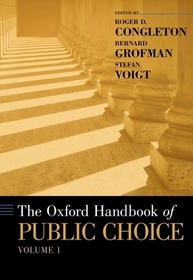
The Oxford Handbook of Public Choice, Volume 1
Series: Oxford Handbooks;
- Publisher's listprice GBP 162.50
-
73 368 Ft (69 875 Ft + 5% VAT)
The price is estimated because at the time of ordering we do not know what conversion rates will apply to HUF / product currency when the book arrives. In case HUF is weaker, the price increases slightly, in case HUF is stronger, the price goes lower slightly.
- Discount 10% (cc. 7 336 Ft off)
- Discounted price 66 032 Ft (62 888 Ft + 5% VAT)
Subcribe now and take benefit of a favourable price.
Subscribe
73 368 Ft

Availability
printed on demand
Why don't you give exact delivery time?
Delivery time is estimated on our previous experiences. We give estimations only, because we order from outside Hungary, and the delivery time mainly depends on how quickly the publisher supplies the book. Faster or slower deliveries both happen, but we do our best to supply as quickly as possible.
Product details:
- Publisher OUP USA
- Date of Publication 31 January 2019
- ISBN 9780190469733
- Binding Hardback
- No. of pages984 pages
- Size 249x183x58 mm
- Weight 1792 g
- Language English 0
Categories
Short description:
The Oxford Handbook of Public Choice provides a comprehensive overview of the research in economics, political science, law, and sociology that has generated considerable insight into the politics of democratic and authoritarian systems.
MoreLong description:
The Oxford Handbook of Public Choice provides a comprehensive overview of the research in economics, political science, law, and sociology that has generated considerable insight into the politics of democratic and authoritarian systems as well as the influence of different institutional frameworks on incentives and outcomes. The result is an improved understanding of public policy, public finance, industrial organization, and macroeconomics as the combination of political and economic analysis shed light on how various interests compete both within a given rules of the games and, at times, to change the rules. These volumes include analytical surveys, syntheses, and general overviews of the many subfields of public choice focusing on interesting, important, and at times contentious issues. Throughout the focus is on enhancing understanding how political and economic systems act and interact, and how they might be improved.
Both volumes combine methodological analysis with substantive overviews of key topics. This first volume covers voting and elections; interest group competition and rent seeking, including corruption and various normative approaches to evaluating policies and politics.
Throughout both volumes important analytical concepts and tools are discussed, including their application to substantive topics. Readers will gain increased understanding of rational choice and its implications for collective action; various explanations of voting, including economic and expressive; the role of taxation and finance in government dynamics; how trust and persuasion influence political outcomes; and how revolution, coups, and authoritarianism can be explained by the same set of analytical tools as enhance understanding of the various forms of democracy.
The articles are written for serious readers, and they give clear and concise statements of the material they cover... the essays in this Handbook will provide wonderful insights into the present state of public choice.
Table of Contents:
PART I: Introductory Essays
1. Rational Choice and Politics: An Introduction to the Research Program and Methodology of Public Choice
Roger D. Congleton
2. Choosing among Governments
Alan Hamlin
3. Public Choice: Early Contributions
Dennis C. Mueller
PART II: VOTING AND ELECTIONS
A. Modelling Collective Choice in Voting
4. From Paired Comparisons and Cycles to Arrow's Theorem
Donald G. Saari
5. Institution-induced Stability
Kenneth A. Shepsle
6. Voting Power
Stefan Napel
7. Aggregation of Information by Binary Voting Rules
Shmuel Nitzan and Jacob Paroush
B. Spatial Voting Models
8. Political Choices in One Dimension: Theory
Bernard Grofman
9. Political Choices in One Dimension: Applications
Bernard Grofman
10. Spatial Voting Models of Party Competition in Two Dimensions
James F. Adams
11. Spatial Social Choice
Norman Schofield
C. Other Aspects of Voter and Party Choice
12. Economic Voting
Michael S. Lewis-Beck and Mary Stegmaier
13. Valence Politics
Haldun Evrenk
14. The Study of Strategic Voting
André Blais and Arianna Degan
15. Turnout: Why do voters vote?
Serguei Kaniovski
16. Expressive Voting
Alan Hamlin and Colin Jennings
17. Altruism and Political Participation
Richard Jankowski
18. Social Embeddedness and Rational Turnout
Carole Jean Uhlaner
19. Information cues and rational ignorance
Shaun Bowler and Stephen P. Nicholson
20. Manipulation
Charles R. Plott
D. Democracy in Practice
21. Campaign Finance
Thomas Stratmann
22. Primaries, conventions, and other methods for nominating candidates: How do they matter?
Gilles Serra
23. Logrolling and Coalitions
Anthony J. McGann
PART III: INTEREST GROUP POLITICS AND RENT SEEKING
A. Interest Group Politics
24. Collective Action
Jac C. Heckelman
25. Rent seeking: The social cost of contestable benefits
Arye L. Hillman and Ngo Van Long
26. The Structure of Contests and the Extent of Dissipation
Karl Wärneryd
27. The Political Economy of Rent Creation and Rent Extraction
Roger D. Congleton
28. Empirical evidence on rent seeking costs
Ignacio Del Rosal
B. Political Agency Problems and Trust in Government
29. 'The Bureaucracy' as an Interest Group
Patrick Dunleavy
30. Interest Groups and Regulatory Capture
William F. Shughart II and Diana W. Thomas
31. Corruption
Toke Aidt
32. The Political Economy of Trust
Christian Bjørnskov
C. Persuasion
33. Contested Political Persuasion
Stergios Skaperdas and Samarth Vaidya
34. Stochastic Process Models of Preference Change
Michel Regenwetter and Yung-Fong Hsu
35. Leadership as Persuasion
Benjamin E. Hermalin
PART IV: NORMATIVE POLITICAL THEORY: EVALUATING POLICIES AND POLITIES
36. Fairness Concepts
Christian Klamler
37. Social Contract vs. Invisible Hand: Agreeing to Solve Social Dilemmas
Viktor J. Vanberg
38. Utilitarianism as a Criterion for State Action
Nicolaus Tideman and Florenz Plassmann
39. Public Choice and Happiness
Bruno Frey and Alois Stutzer
40. Kantianism and Political Institutions
Geoffrey Brennan and Hartmut Kliemt
41. Public choice and libertarianism
Peter J. Boettke and Ennio E. Piano
42. Public choice and social democracy
Peter Kurrild-Klitgaard
43. Supreme Values, Totalitarianism and Terrorism
Peter Bernholz
44. Fair Division in Dispute Resolution
Steven J. Brams
45. Fair Division in Allocating Cabinet Ministries
Steven J. Brams

