

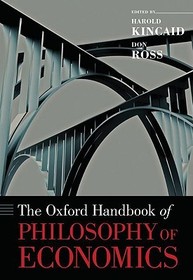
The Oxford Handbook of Philosophy of Economics
Series: Oxford Handbooks;
- Publisher's listprice GBP 177.50
-
80 141 Ft (76 325 Ft + 5% VAT)
The price is estimated because at the time of ordering we do not know what conversion rates will apply to HUF / product currency when the book arrives. In case HUF is weaker, the price increases slightly, in case HUF is stronger, the price goes lower slightly.
- Discount 10% (cc. 8 014 Ft off)
- Discounted price 72 127 Ft (68 693 Ft + 5% VAT)
Subcribe now and take benefit of a favourable price.
Subscribe
80 141 Ft

Availability
printed on demand
Why don't you give exact delivery time?
Delivery time is estimated on our previous experiences. We give estimations only, because we order from outside Hungary, and the delivery time mainly depends on how quickly the publisher supplies the book. Faster or slower deliveries both happen, but we do our best to supply as quickly as possible.
Product details:
- Publisher OUP USA
- Date of Publication 26 March 2009
- ISBN 9780195189254
- Binding Hardback
- No. of pages688 pages
- Size 178x249x53 mm
- Weight 1333 g
- Language English
- Illustrations 13 line illustrations 0
Categories
Short description:
This volume is the first comprehensive, cohesive, and accessible reference source to the philosophy of economics, presenting important new scholarship by top scholars.
MoreLong description:
The Oxford Handbook of Philosophy of Economics is a cutting-edge reference work to philosophical issues in the practice of economics. It is motivated by the view that there is more to economics than general equilibrium theory, and that the philosophy of economics should reflect the diversity of activities and topics that currently occupy economists. Contributions in the Handbook are thus closely tied to ongoing theoretical and empirical concerns in economics.
Contributors include both philosophers of science and economists. Chapters fall into three general categories: received views in philosophy of economics, ongoing controversies in microeconomics, and issues in modeling, macroeconomics, and development. Specific topics include methodology, game theory, experimental economics, behavioral economics, neuroeconomics, computational economics, data mining, interpersonal comparisons of utility, measurement of welfare and well being, growth theory and development, and microfoundations of macroeconomics.
The Oxford Handbook of Philosophy of Economics is a groundbreaking reference like no other in its field. It is a central resource for those wishing to learn about the philosophy of economics, and for those who actively engage in the discipline, from advanced undergraduates to professional philosophers, economists, and historians.
Certainly, The Oxford Handbook of Philosophy of Economics will become one of the standard references for philosophers of economics.
Table of Contents:
Preface
Acknowledgements
Notes on Contributors
Chapter 1: The New Philosophy of Economics: Don Ross and Harold Kincaid
Section 1: Received Views in Philosophy of Economics
Chapter 2: Laws, Causation and Economic Methodology: Daniel Hausman
Chapter 3: If Economics Is a Science, What Kind of a Science Is It?: Alex Rosenberg
Chapter 4: Realistic Realism about Unrealistic Models: Uskali Mäki
Chapter 5: Why There Is (as Yet) No Such Thing as an Economics of Knowledge: Philip Mirowski
Section 2: Microeconomis
Chapter 6: Rationality and Indeterminacy: Cristina Bicchieri
Chapter 7: Experimental Investigations of Social Preferences: Jim Woodward
Chapter 8: Competing Conceptions of the Individual in Recent Economics: John B. Davis
Chapter 9: Integrating the Dynamics of Multi-scale Economic Agency: Don Ross
Chapter 10: Methodological Issues in Experimental Design and Interpretation: Francesco Guala
Chapter 11: Progress in Economics - Lessons from the Spectrum Auctions: Anna Alexandrova and Robert Northcott
Chapter 12: Advancing Evolutionary Explanations in Economics: Jack Vromen
Section 3: Modeling, Macroeconomics And Development
Chapter 13: Computational Economics: Paul Humphreys
Chapter 14: Microfoundations and the Ontology of Macroeconomics: Kevin D. Hoover
Chapter 15: Causality, Invariance, and Policy: Nancy Cartwright
Chapter 16: The Miracle of the Septuagint and the Promise of Data Mining in Economics: Stan du Plessis
Chapter 17: Explaining Growth: Harold Kincaid
Chapter 18: Multisector Labor Market Models: Gary Fields
Section 4: Welfare
Chapter 19: What is Welfare and How Can We Measure it?: Keith Dowding
Chapter 20: Interpersonal Comparison of Utility: Ken Binmore
Chapter 21: Subjective Measures of Well-Being: Philosophical Perspectives: Erik Angner
Chapter 22: Facts and Values in Modern Economics
: Partha Dasgupta

