

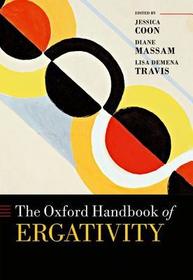
The Oxford Handbook of Ergativity
Series: Oxford Handbooks;
- Publisher's listprice GBP 150.00
-
71 662 Ft (68 250 Ft + 5% VAT)
The price is estimated because at the time of ordering we do not know what conversion rates will apply to HUF / product currency when the book arrives. In case HUF is weaker, the price increases slightly, in case HUF is stronger, the price goes lower slightly.
- Discount 10% (cc. 7 166 Ft off)
- Discounted price 64 496 Ft (61 425 Ft + 5% VAT)
Subcribe now and take benefit of a favourable price.
Subscribe
71 662 Ft

Availability
Estimated delivery time: In stock at the publisher, but not at Prospero's office. Delivery time approx. 3-5 weeks.
Not in stock at Prospero.
Why don't you give exact delivery time?
Delivery time is estimated on our previous experiences. We give estimations only, because we order from outside Hungary, and the delivery time mainly depends on how quickly the publisher supplies the book. Faster or slower deliveries both happen, but we do our best to supply as quickly as possible.
Product details:
- Publisher OUP Oxford
- Date of Publication 15 June 2017
- ISBN 9780198739371
- Binding Hardback
- No. of pages1296 pages
- Size 246x171 mm
- Weight 1890 g
- Language English 0
Categories
Short description:
This volume examines the phenomenon of ergativity, a grammatical patterning whereby direct objects are in some way treated like intransitive subjects, to the exclusion of transitive subjects. It includes theoretical approaches from generative, typological, and functional paradigms, as well as 16 language-specific case studies.
MoreLong description:
This volume offers theoretical and descriptive perspectives on the issues pertaining to ergativity, a grammatical patterning whereby direct objects are in some way treated like intransitive subjects, to the exclusion of transitive subjects. This pattern differs markedly from nominative/accusative marking whereby transitive and intransitive subjects are treated as one grammatical class, to the exclusion of direct objects. While ergativity is sometimes referred to as a typological characteristic of languages, research on the phenomenon has shown that languages do not fall clearly into one category or the other and that ergative characteristics are not consistent across languages.
Chapters in this volume look at approaches to ergativity within generative, typological, and functional paradigms, as well as approaches to the core morphosyntactic building blocks of an ergative construction; related constructions such as the anti-passive; related properties such as split ergativity and word order; and extensions and permutations of ergativity, including nominalizations and voice systems. The volume also includes results from experimental investigations of ergativity, a relatively new area of research. A wide variety of languages are represented, both in the theoretical chapters and in the 16 case studies that are more descriptive in nature, attesting to both the pervasiveness and diversity of ergative patterns.
Table of Contents:
Introduction
PART I: ACCOUNTING FOR ERGATIVITY
Representing Ergativity
Ergativity in discourse and grammar
Parameterizing ergativity: An inherent case approach
Accusative and ergative in Hindi
The Nature of Ergative Case
On inherent and dependent theories of ergative case
The locus of ergative case
Ergative need not split: An exploration into the TotalErg hypothesis
The structural source of split ergativity and ergative case in Georgian
PART II: CHARACTERISTICS AND EXTENSIONS
Characteristics
Split ergativity in syntax and at morphological spellout
Split ergativity is not about ergativity
Ergativity and differential case marking
Three-way systems do not exist
Antipassive
Remarks on the relation between case-alignment and constituent order
Extensions
Ergativity in nominalization
Ergativity and Austronesian-type voice systems
On the morphosyntactic reflexes of the information structure in the ergative patterning of the Inuit language
Ergative constellations in the structure of speech acts
PART III: APPROACHES TO ERGATIVITY
DIACHRONIC
Grammaticalization of ergative case marking
Deconstructing Iranian ergativity
Intransitivity and the development of ergative alignment
Developments into and out of ergativity: Indo-Aryan diachrony
Ergativity and language change in Austronesian languages
Lexical category and alignment in Austronesian
Acquisition
The acquisition of ergativity: An overview
The role of defaults in the acquisition of Basque ergative and dative morphology
A comparative study of the acquisition of nominative and ergative alignment in European and Mayan languages
Experimental
Processing ergativity: Behavioral and electrophysiological evidence
Experimental approaches to ergative languages
PART IV: CASE STUDIES
Correlates of ergativity in Mayan
Ergative case in Burushaski: A dependent case analysis
Ergativity in Basque
Hindi/Urdu and related languages
Ergativity in Inuktitut
Ergativity in Nakh-Dagestanian
Ergativity in Neo-Aramaic
Ergativity in Africa
Ergativity in Tibeto-Burman
The ergative in Warlpiri: A case study
Ergative-absolutive patterns in Tongan: An overview
Ergativity across Tsimshianic
What being a syntactically ergative language means for Katukina-Kanamari
Ergativity in Jê languages
Interaction of ergativity and information structure in Jaminjung (Australia)
Alignment and orientation in Kartvelian (South Caucasian)

