

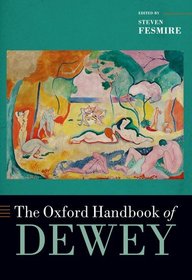
The Oxford Handbook of Dewey
Series: OXFORD HANDBOOKS SERIES;
- Publisher's listprice GBP 39.99
-
18 055 Ft (17 195 Ft + 5% VAT)
The price is estimated because at the time of ordering we do not know what conversion rates will apply to HUF / product currency when the book arrives. In case HUF is weaker, the price increases slightly, in case HUF is stronger, the price goes lower slightly.
- Discount 10% (cc. 1 806 Ft off)
- Discounted price 16 249 Ft (15 476 Ft + 5% VAT)
Subcribe now and take benefit of a favourable price.
Subscribe
18 055 Ft

Availability
Estimated delivery time: In stock at the publisher, but not at Prospero's office. Delivery time approx. 3-5 weeks.
Not in stock at Prospero.
Why don't you give exact delivery time?
Delivery time is estimated on our previous experiences. We give estimations only, because we order from outside Hungary, and the delivery time mainly depends on how quickly the publisher supplies the book. Faster or slower deliveries both happen, but we do our best to supply as quickly as possible.
Product details:
- Publisher OUP USA
- Date of Publication 8 June 2023
- ISBN 9780197669259
- Binding Paperback
- No. of pages808 pages
- Size 244x180x71 mm
- Weight 1315 g
- Language English 402
Categories
Short description:
The Oxford Handbook of Dewey is a comprehensive volume spanning thirty-five chapters, wherein leading scholars help researchers access particular aspects of Dewey's thought, navigate the enormous and rapidly developing literature, and participate in current scholarship in light of prospects in key topical areas. Beginning with a framing essay calling for a transformation of philosophical research inspired by Dewey, contributors interpret, appraise, and critique Dewey's philosophy.
MoreLong description:
John Dewey was the foremost philosophical figure and public intellectual in early to mid-twentieth century America. He is still the most academically cited Anglophone philosopher of the past century, and is among the most cited Americans of any century. In this comprehensive volume spanning thirty-five chapters, leading scholars help researchers access particular aspects of Dewey's thought, navigate the enormous and rapidly developing literature, and participate in current scholarship in light of prospects in key topical areas. Beginning with a framing essay by Philip Kitcher calling for a transformation of philosophical research inspired by Dewey, contributors interpret, appraise, and critique Dewey's philosophy under the following headings: Metaphysics; Epistemology, Science, Language, and Mind; Ethics, Law, and the Starting Point; Social and Political Philosophy, Race, and Feminist Philosophy; Philosophy of Education; Aesthetics; Instrumental Logic, Philosophy of Technology, and the Unfinished Project of Modernity; Dewey in Cross-Cultural Dialogue; The American Philosophical Tradition, the Social Sciences, and Religion; and Public Philosophy and Practical Ethics.
MoreTable of Contents:
Notes on Contributors
Introduction
Steven Fesmire
I. The Future of Philosophical Research
1. Dewey's Conception of Philosophy: Philip Kitcher,
II. Metaphysics
2. Dewey's Naturalistic Metaphysics: Thomas M. Alexander
3. Dewey, Whitehead, and Process Metaphysics: William T. Myers
III. Epistemology, Science, Language, and Mind
4. Pragmatist Portraits of Experimental Intelligence by Peirce, James, Dewey, and Others: Vincent Colapietro
5. Dewey, Rorty, and Brandom: The Challenges of Linguistic Neopragmatism: David Hildebrand
6. Pragmatist Innovations, Actual and Proposed: Dewey, Peirce, and the Pittsburgh School: Joseph Margolis
7. Dewey and Anti-Representationalism: Peter Godfrey-Smith
IV. Ethics, Law, and the Starting Point
8. Dewey's Radical Conception of Moral Cognition: Mark Johnson
9. Dewey on the Authority and Legitimacy of Law: Cheryl Misak
10. Beyond Moral Fundamentalism: Dewey's Pragmatic Pluralism in Ethics and Politics: Steven Fesmire
11. The Starting Point of Dewey's Ethics and Sociopolitical Philosophy: Gregory F. Pappas
V. Social and Political Philosophy, Race, and Feminist Philosophy
12. Dewey and Du Bois on Race and Colonialism: Shannon Sullivan
13. Dewey and Pragmatist Feminist Philosophy: Lisa Heldke
14. Dewey's Pragmatic Politics: Power, Limits, and Realism About Democracy as a Way of Life, John J. Stuhr
15. Dewey, Addams, and Design Thinking: Pragmatist Feminist Innovation for Democratic Change, Judy D. Whipps
VI. Philosophy of Education
16. Dewey and the Quest for Certainty in Education, Nel Noddings
17. Derridean Poststructuralism, Deweyan Pragmatism, and Education, Jim Garrison
18. Dewey, the Ethics of Democracy, and the Challenge of Social Inclusion in Education, Maura Striano
19. Dewey and Higher Education, Leonard J. Waks
20. Dewey, Aesthetic Experience, and Education for Humanity: Andrea English and Christine Doddington
VII. Aesthetics
21. Dewey's Art as Experience in the Landscape of Twenty-first Century Aesthetics: Casey Haskins
22. Dewey, Adorno, and the Purpose of Art: Espen Hammer
VIII. Instrumental Logic, Philosophy of Technology, and the Unfinished Project of Modernity
23. Dewey, Pragmatism, Technology: Larry A. Hickman
24. Dewey's Chicago-Functionalist Conception of Logic: F. Thomas Burke
25. Dewey, Habermas, and the Unfinished Project of Modernity in Unmodern Philosophy and Modern Philosophy: Phillip Deen
IX. Dewey in Cross-Cultural Dialogue
26. Dewey and Confucian Philosophy: Roger Ames
27. Two-Way Internationalization: Education, Translation, and Transformation in Dewey and Cavell: Naoko Saito
28. Experimental Democracy for China: Dewey's Method: Sor-hoon Tan
X. The American Philosophical Tradition, the Social Sciences, and Religion
29. John Dewey's Debt to William James: James Campbell
30. Mead, Dewey, and Their Influence in the Social Sciences: Daniel R. Huebner
31. Idealism and Religion in Dewey's Philosophy: Randall E. Auxier and John R. Shook
32. Philosophy and the Mirror of Culture: On the Future and Function of Dewey Scholarship: Erin McKenna and Scott Pratt
XI. Public Philosophy and Practical Ethics
33. Dewey and Public Philosophy: Noëlle McAfee
34. Dewey and Environmental Philosophy: Paul B. Thompson and Zachary Piso
35. Dewey and Bioethics: D. Micah Hester

