

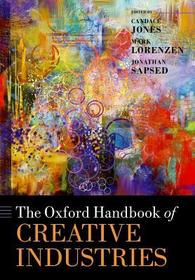
The Oxford Handbook of Creative Industries
Series: Oxford Handbooks;
- Publisher's listprice GBP 36.99
-
17 671 Ft (16 830 Ft + 5% VAT)
The price is estimated because at the time of ordering we do not know what conversion rates will apply to HUF / product currency when the book arrives. In case HUF is weaker, the price increases slightly, in case HUF is stronger, the price goes lower slightly.
- Discount 10% (cc. 1 767 Ft off)
- Discounted price 15 904 Ft (15 147 Ft + 5% VAT)
Subcribe now and take benefit of a favourable price.
Subscribe
17 671 Ft

Availability
printed on demand
Why don't you give exact delivery time?
Delivery time is estimated on our previous experiences. We give estimations only, because we order from outside Hungary, and the delivery time mainly depends on how quickly the publisher supplies the book. Faster or slower deliveries both happen, but we do our best to supply as quickly as possible.
Product details:
- Publisher OUP Oxford
- Date of Publication 5 October 2017
- ISBN 9780198787792
- Binding Paperback
- No. of pages576 pages
- Size 246x171 mm
- Weight 984 g
- Language English 0
Categories
Short description:
This book discusses creative industries from the perspectives of economics, management, psychology, law, geography, and policy. The book combines views on how creativity is turned into economic, business and social value, as well as contemporary trends, digital technologies and creative industries in emerging economies such as China and India
MoreLong description:
The Oxford Handbook of Creative Industries is a reference work, bringing together many of the world's leading scholars in the application of creativity in economics, business and management, law, policy studies, organization studies, and psychology. Creative industries research has become a regular theme in academic journals and conferences across these subjects and is also an important agenda for governments throughout the world, while business people from established companies and entrepreneurs revaluate and innovate their models in creative industries.
The Handbook is organized into four parts: Following the editors' introduction, Part One on Creativity includes individual creativity and how this scales up to teams, social networks, cities, and labour markets. Part Two addresses Generating and Appropriating Value from Creativity, as achieved by agents and organizations, such as entrepreneurs, stars and markets for symbolic goods, and considers how performance is measured in the creative industries.
Part Three covers the mechanics of Managing and Organizing Creative Industries, with chapters on the role of brokerage and mediation in creative industry networks, disintermediation and glocalisation due to digital technology, the management of project-based organzations in creative industries, organizing events in creative fields, project ecologies, Global Production Networks, genres and classification and sunk costs and dynamics of creative industries.
Part Four on Creative Industries, Culture and the Economy offers chapters on cultural change and entrepreneurship, on development, on copyright, economic spillovers and government policy.
This authoritative collection is the most comprehensive source of the state of knowledge in the increasingly important field of creative industries research. Covering emerging economies and new technologies, it will be of interest to scholars and students of the arts, business, innovation, and policy.
Table of Contents:
Part I: Introduction
Creative Industries: A Typology of Change
Part II: Creativity
The Creative Mind
Creativity in Teams: Processes and Outcomes in Creative Industries
Creativity in Social Networks: A Core-Periphery Perspective
Creativity in the City
Part III: Valuing Creativity and Creating Value
The Market for Symbolic Goods: Translating Economic and Symbolic Capitals in Creative Industries
Trading Places: Auctions and the Rise of the Chinese Art Market
The Market for Creative Labor: Talent and Inequalities
Stars and Stardom in the Creative Industries
Creative Entrepreneurs: The Business Models of Haute Cuisine Chefs
Entrepreneurship in Creative Industries and Cultural Change: Art, Fashion, and Modernity in India
Performance in the Creative Industries
Part IV: Organizing Creative Industries
Projects and Project Ecologies in Creative Industries
Managing Project-Based Organization in Creative Industries
Organizing Events for Configuring and Maintaining Creative Fields
User Innovation in Creative Industries
User Innovation in the Music Software Industry: The Case of Sibelius
Niches, Genres, and Classifications in the Creative Industries
Part V: Industrial Organisation and Creative Economy
Sunk Costs and the Dynamics of Creative Industries
Creative Industry and the Wider Economy
Brokerage, Mediation, and Social Networks in the Creative Industries
Digitizing Fads and Fashions: Disintermediation and Glocalized Markets in Creative Industries
Part VI:Policy and Development
Copyright, The Creative Industries and The Public Domain
Copyright and its Discontents
Public Policy for the Creative Industries
Global Production Networks in the Creative Industries
Creative Industries and Development: Culture in Development, or the Cultures of Development?

