

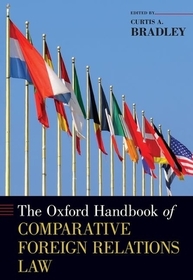
The Oxford Handbook of Comparative Foreign Relations Law
Series: Oxford Handbooks;
- Publisher's listprice GBP 165.00
-
78 828 Ft (75 075 Ft + 5% VAT)
The price is estimated because at the time of ordering we do not know what conversion rates will apply to HUF / product currency when the book arrives. In case HUF is weaker, the price increases slightly, in case HUF is stronger, the price goes lower slightly.
- Discount 10% (cc. 7 883 Ft off)
- Discounted price 70 946 Ft (67 568 Ft + 5% VAT)
Subcribe now and take benefit of a favourable price.
Subscribe
78 828 Ft

Availability
Estimated delivery time: In stock at the publisher, but not at Prospero's office. Delivery time approx. 3-5 weeks.
Not in stock at Prospero.
Why don't you give exact delivery time?
Delivery time is estimated on our previous experiences. We give estimations only, because we order from outside Hungary, and the delivery time mainly depends on how quickly the publisher supplies the book. Faster or slower deliveries both happen, but we do our best to supply as quickly as possible.
Product details:
- Publisher OUP USA
- Date of Publication 5 September 2019
- ISBN 9780190653330
- Binding Hardback
- No. of pages896 pages
- Size 180x249x61 mm
- Weight 1656 g
- Language English 0
Categories
Short description:
This 46-chapter book, written by leading experts across the globe, compares and contrasts the foreign relations law of nations around the world, both documenting important differences and also noting commonalities and emerging trends. Comparative foreign relations law is a newly emerging field of study and teaching, and this volume is likely to become a key reference work as the field continues to develop.
MoreLong description:
This Oxford Handbook ambitiously seeks to lay the groundwork for the relatively new field of comparative foreign relations law. Comparative foreign relations law compares and contrasts how nations, and also supranational entities (for example, the European Union), structure their decisions about matters such as entering into and exiting from international agreements, engaging with international institutions, and using military force, as well as how they incorporate treaties and customary international law into their domestic legal systems. The legal materials that make up a nation's foreign relations law can include constitutional law, statutory law, administrative law, and judicial precedent, among other areas.
This book consists of 46 chapters, written by leading authors from around the world. Some of the chapters are empirically focused, others are theoretical, and still others contain in-depth case studies. In addition to being an invaluable resource for scholars working in this area, the book should be of interest to a wide range of lawyers, judges, and law students. Foreign relations law issues are addressed regularly by lawyers working in foreign ministries, and globalization has meant that domestic judges, too, are increasingly confronted by them. In addition, private lawyers who work on matters that extend beyond their home countries often are required to navigate issues of foreign relations law. An increasing number of law school courses in comparative foreign relations law are also now being developed, making this volume an important resource for students as well. Comparative foreign relations law is a newly emerging field of study and teaching, and this volume is likely to become a key reference work as the field continues to develop.
Developed and edited by one of the pre-eminent scholars of U.S. foreign relations law, this Oxford Handbook is one of those rare volumes that persuasively lays the cornerstone of a new area of legal research. The book brings together leading scholars from five continents to extract new insights about how states navigate the interplay between their external and domestic obligations. This is the book on which comparative foreign relations scholars will build their future work.
Table of Contents:
Preface Curtis A. Bradley
Notes on the Contributors
Part I: Comparative Foreign Relations Law as a Field
Chapter 1: Curtis A. Bradley, What is Foreign Relations Law?
Chapter 2: Campbell McLachlan, Five Conceptions of the Function of Foreign Relations Law
Chapter 3: Karen Knop, Foreign Relations Law: Comparison as Invention
Chapter 4: Tom Ginsburg, Comparative Foreign Relations Law:
A National Constitutions Perspective
Chapter 5: Oona A. Hathaway, A Comparative Foreign Relations Law Agenda:
Opportunities and Challenges
Chapter 6: Jenny S. Martinez, The Constitutional Allocation of Executive and
Legislative Power Over Foreign Affairs: A Survey
Chapter 7: Alejandro Rodiles, Executive Power in Foreign Affairs: The Case for
Inventing a Mexican Foreign Relations Law
Part II. Making Treaties and Other International Agreements
Chapter 8: Pierre-Hugues Verdier & Mila Versteeg, Separation of Powers,
Treaty-Making, and Treaty Withdrawal: A Global Survey
Chapter 9: Jean Galbraith, International Agreements and U.S. Foreign Relations Law:
Complexity in Action
Chapter 10: Stefan Kadelbach, International Treaties and the German Constitution
Chapter 11: Tadaatsu Mori, The Current Practice of Making and Applying International
Agreements in Japan
Chapter 12: Carlos Esposito, Spanish Foreign Relations Law and the Process for
Making Treaties and Other International Agreements
Chapter 13: Jaemin Lee, Incorporation and Implementation of Treaties in South Korea
Chapter 14: Marise Cremona, Making Treaties and Other International Agreements:
The European Union
Part III. Federalism and Foreign Affairs
Chapter 15: Ernest A. Young, Foreign Affairs Federalism in the United States
Chapter 16: Charles-Emmanuel Côté, Federalism and Foreign Affairs in Canada
Chapter 17: Roland Portmann, Foreign Affairs Federalism in Switzerland
Chapter 18: Anamika Asthana and Happymon Jacob, Federalism and Foreign Affairs in India
Chapter 19: Robert Schütze, Foreign Affairs Federalism in the European Union
Part IV. Engaging With, and Disengaging From, International Institutions
Chapter 20: Laurence R. Helfer, Treaty Exit and Intra-Branch Conflict at the Interface of
International and Domestic Law
Chapter 21: Paul B. Stephan, Constitutionalism and Internationalism: U.S Participation in
International Institutions
Chapter 22: Paul Craig, Engagement and Disengagement with International Institutions:
The UK Perspective
Chapter 23: Andreas L. Paulus & Jan-Henrik Hinselmann, "International Integration and Its
Counter-Limits: A German Constitutional Perspective"
Chapter 24: Hannah Woolaver, State Engagement with Treaties: Interactions Between International and Domestic Law
Chapter 25: Joris Larik, Regional Organizations' Relations with International Institutions:
The EU and ASEAN Compared
Part V. Domestic Application of International Law
Chapter 26: Duncan B. Hollis & Carlos M. Vázquez, Treaty Self-Execution as
"Foreign" Foreign Relations Law
Chapter 27: Shaheed Fatima, The Domestic Application of International Law in
British Courts
Chapter 28: Gib Van Ert, The Domestic Application of International Law in Canada
Chapter 29: Amichai Cohen, International Law in Israeli Courts
Chapter 30: Hiromichi Matsuda, International Law in Japanese Courts
Chapter 31: Congyan Cai, International Law in Chinese Courts
Chapter 32: Rene Urue?a, Domestic Application of International Law in Latin America
Chapter 33: Ernest Yaw Ako and Richard Frimpong Oppong, Foreign Relations Law
in the Constitutions and Courts of Commonwealth African Countries
Chapter 34: Mario Mendez, The Application of International Law by the Court of Justice
of the European Union
Part VI. Immunity, Comity, and Related Issues
Chapter 35: David P. Stewart, International Immunities in U.S. Law
Chapter 36: Philippa Webb, International Immunities in English Law
Chapter 37: Hennie Strydom, South African Law on Immunities
Chapter 38: Andrea Bianchi, Jurisdictional Immunities, Constitutional Values,
and System Closures
Chapter 39: William S. Dodge, International Comity in Comparative Perspective
Chapter 40: Eirik Bjorge & Cameron Miles, Crown and Foreign Acts of State
Before British Courts: Ramatullah, Belhaj, and the Separation of Powers
Part VII: The Use of Military Force
Chapter 41: Monica Hakimi, Techniques for Regulating Military Force
Chaper 42: Curtis A. Bradley, U.S. War Powers and the Potential Benefits of Comparativism
Chaper 43: Katja S. Ziegler, The Use of Force by the United Kingdom: The Evolution of
Accountability
Chapter 44: Anne Peters, Military Operations Abroad Under the German Basic Law
Chaper 45: Mathias Forteau, Using Military Force and Engaging in Collective Security:
The Case of France
Chapter 46: Tadashi Mori, Decisions in Japan to Use Military Force or to Participate in
Multinational Peacekeeping Operations

