

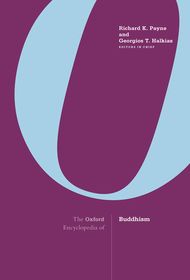
The Oxford Encyclopedia of Buddhism
- Publisher's listprice GBP 385.00
-
173 827 Ft (165 550 Ft + 5% VAT)
The price is estimated because at the time of ordering we do not know what conversion rates will apply to HUF / product currency when the book arrives. In case HUF is weaker, the price increases slightly, in case HUF is stronger, the price goes lower slightly.
- Discount 10% (cc. 17 382 Ft off)
- Discounted price 156 445 Ft (148 995 Ft + 5% VAT)
Subcribe now and take benefit of a favourable price.
Subscribe
173 827 Ft

Availability
Estimated delivery time: In stock at the publisher, but not at Prospero's office. Delivery time approx. 3-5 weeks.
Not in stock at Prospero.
Why don't you give exact delivery time?
Delivery time is estimated on our previous experiences. We give estimations only, because we order from outside Hungary, and the delivery time mainly depends on how quickly the publisher supplies the book. Faster or slower deliveries both happen, but we do our best to supply as quickly as possible.
Product details:
- Publisher OUP USA
- Date of Publication 23 December 2024
- ISBN 9780190256890
- Binding Hardback
- No. of pages1400 pages
- Size 274x170x195 mm
- Weight 5829 g
- Language English 548
Categories
Short description:
The Oxford Encyclopedia of Buddhism is a first-of-its-kind reference project: a systematic effort to identify and analyze the ways in which Buddhist studies has developed, the new sub-fields of inquiry, and the evolving relationships between disciplines that broaden our knowledge of the religion. The Encyclopedia draws from a wide range of scholarly perspectives, and its 138 chapters cover several major thematic areas, including historical and historiographical studies, historical figures, buddhas and deities, regional studies, global and diasporic Buddhism, art and architecture, contemporary social and academic issues, rituals, philosophical and doctrinal studies, textual and philological studies, and the most influential educational institutions.
MoreLong description:
The earliest examples of Buddhist studies originating in the Western world tended to frame Buddhism as a religion similar to Abrahamic monotheisms. This involved, among other things, an emphasis on philological, doctrinal, and textual studies, as well as an assumption that the Buddha compares directly to the messianic figures central to other traditions. Starting in the late twentieth century, Buddhist studies scholars have been creatively moving outside of this rubric, and indeed outside of the familiar boundaries of the academy. This movement has allowed them to examine subjects, perspectives, and methodologies not previously engaged by the mainstream of Buddhist studies. Such a wider approach fosters greater awareness of external versus internal critiques of the religion, inclusion of new disciplines and previously marginalized voices, and an appreciation of the decentralized nature of Buddhism and the varied personal experiences of lived practice. As a result, Buddhist studies has attracted a growing audience within the humanities and has been at the forefront of the discourse on cultural exchange, globalization, colonialism and postcolonialism, and the ongoing changes in the religious landscape.
Reflecting these innovations, The Oxford Encyclopedia of Buddhism is a first-of-its-kind reference project: a systematic effort to identify and analyze the ways in which Buddhist studies continues to develop, the new sub-fields of inquiry, and the evolving relationships between the related disciplines. Consisting of 138 in-depth articles, the Encyclopedia covers several major thematic areas, including historical and historiographical studies, historical figures, buddhas and deities, regional studies, global and diasporic Buddhism, art and architecture, contemporary social and academic issues, rituals, philosophical and doctrinal studies, textual and philological studies, and the most influential educational institutions. Moreover, the Encyclopedia frames Buddhist studies as a field rather than as a discipline, meaning that it covers a rich variety of intellectual projects. This approach balances independent specialized studies with interconnected and interdisciplinary studies, inviting research that is both sharper and more nuanced. It is this perspective, gazing toward the future of the field, that marks the volume as an essential work of contemporary scholarship and an organically evolving encyclopedia for study and research.
The articles are all substantial works of scholarship written by top scholars in the field; each provides useful surveys of existing scholarship, ample notes, and "Further Reading," making this resource an excellent starting place for the many research topics it covers.
Table of Contents:
Abhidharmakośabhāsya (Treasury of Metaphysics with Self-Commentary)
Abhisamayālamkāra (Ornament for Clear Realization)
American Buddhism during World War II Imprisonment
Amoghavajra
Art, Architecture and National Memory-Making
Avalokiteśvara: The Bodhisattva of Compassion
Bodhisattvabhūmi (The Bodhisattva Stages)
The Body of the Buddha
The Bön Tradition of Dzogchen
Buddhaghosa
Buddhism and Bioethics
Buddhism and Biography
Buddhism and Globalization
Buddhism and Healing in China
Buddhism and Media
Buddhism and Medicine in India
Buddhism and Medicine in Japan
Buddhism and Medicine in Premodern Japan
Buddhism and Print Culture in China
Buddhism and Shinto
Buddhism and the Environment
Buddhism in Colonial Contexts
Buddhism in Film
Buddhisms in Diaspora: The Canadian Context of Chinese Buddhism
Buddhist Art and Architecture in Tibet
Buddhist Chaplaincy
Buddhist Cosmology
Buddhist Geography and Regionalism
Buddhist Meditation and Contemplation
Buddhist Philosophy as Philosophy
Buddhist Wall Paintings
Buddhist Wizards (Vidhyadhāra/Weizzā/Weikza): Contemporary Burma/Myanmar
Buddhist Wizards (Vidhyadhāra/Weizzā/Weikza): Origins and History
Candrakīrti's Middle Way Philosophy
Canon and Commentary in the Earliest Buddhist Manuscripts
Chan Literature
Chöd: A Tibetan Buddhist Practice
D.T. Suzuki: A Biography
D.T. Suzuki: Ideas and Influences
Debate in the Tibetan Tradition
Debate Traditions in Premodern Japan
Domestic Dharma in Japan
Dunhuang Art
Dunhuang Texts
Dzogchen
Early History of the Drukpa Kagyü School
Early Modern European Encounters with Buddhism
The Economics of Buddhism
Engaged Buddhism
Epigraphy and the Study of Buddhism: South Asia's Northern Corridor
Esoteric Buddhism in Southeast Asia
Ethics and Buddhism
Filial Piety in Chinese Buddhism
Fo Guang Shan
Four Noble Truths
From Manuscript to Print in South and Southeast Asia
Gelukpa
Global Buddhism
Global Theravada Buddhism: Asian Foundations
Global Theravada: Transmission Beyond Asia
Globalizing Tantric Buddhism
Guardian/Protector Deities in Tibetan Buddhism
History of Buddhisms in China: the Nanbeicho Period (Late 4th Century to the Sui Dynasty)
Homa: Tantric Fire Ritual
Hsing Yun
Huineng
Humanistic Buddhism (Rensheng Fojiao 人生佛教 / Renjian Fojiao 人間佛教)
Imaging the Buddha in South Asia
The Imamura Families and the Making of American Buddhism
Intention
Japanese Buddhisms in Diaspora
Jātaka
Jebtsundamba Khutugtus of Mongolia
The Kadampa: A Formative Movement of Tibetan Buddhism
Kālacakra-Mandala: Symbolism and Construction
Longchenpa
Madhyamaka
Mahāmudrā in India and Tibet
Mañjuśrī
Maritime Buddhism
Marpa Lotsawa Chökyi Lodrö
Mipam
Monastic Education in Contemporary Asia
Mongolian Buddhism in the Democratic Period
Mongolian Buddhism in the Early 20th Century
Mongolian Buddhism in the Yuan Period
Muslim-Buddhist Relations and Buddhism in Muslim Sources until the Mongol Period
Nāgārjuna
Naikan: A Meditation Method and Psychotherapy
Narratives of Buddhist Relics and Images
Nechung: A Tibetan Buddhist Oracle
Nichiren
Patronage of Buddhist Monasteries in Eastern India (600-1300 CE)
Perfections (Six and Ten) of Bodhisattvas in Buddhist Literature
The Philosophical Works and Influence of Dignāga and Dharmakīrti
Pilgrimage in Buddhist Tibet
Pilgrimage in China
Practices of Protection in the Pali World
Prajñāpāramitā and Khmer Esoteric Buddhism in the 10th to 13th centuries
Psychological Interpreters of Buddhism
Pure Land Buddhism in Tibetan Contexts
Queering Buddhist Traditions
The Reincarnation System in Central Asian Buddhism
Rennyo
Ryōgen
The Sangha as an Institution
Śāntideva's Introduction to the Practices of Awakening (Bodhicaryāvatāra)
Sarvāstivāda Abhidharma
Secular Buddhism
Sheng Yen
Shingon
The Six Nara Schools
Sōka Gakkai
Southeast Asian Refugees in North America
Sri Lanka's Sinhala Buddhist Guardian Deities: Satara Varan Devi
The Study of Visual Culture in South and Southeast Asian Buddhism
Taixu
Tantra and the Tantric Traditions of Hinduism and Buddhism
Tantric Buddhism in Japan: Kukai and Saicho
Tantric Buddhism in Japan: Shingon, Tendai, and the Esotericization of Japanese Buddhisms
Tantric Revival in China
Theravāda Buddhism
Thích Nhất Hanh in the Context of the Modern Development of Vietnamese Buddhism
Three Turnings of the Wheel of Doctrine (Dharma-Cakra)
Tibetan Book of the Dead (Bardo Thödol)
Tibetan Buddhism and the Gesar Epic
Tibetan Buddhist Power Objects
Tibetan Medicine and its Buddhist Contexts
Tibetan Visionary Buddhism
Transmission of Buddhist Media and Texts
Tri Songdétsen
Tsangpa Gyare (1161-1211), Founder of the Drukpa Kagyü School
Tzu Chi
The Vajrakīla Tantras
Vinaya Rules for Monks and Nuns
Visualization/Contemplation Sutras (Guan Jing)
Western Buddhism and Race
Xuyun
Zhentong (Other-Emptiness)

