

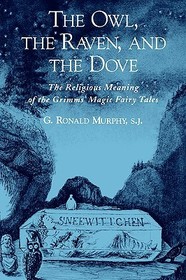
The Owl, The Raven, and the Dove
The Religious Meaning of the Grimms' Magic Fairy Tales
- Publisher's listprice GBP 40.99
-
18 506 Ft (17 625 Ft + 5% VAT)
The price is estimated because at the time of ordering we do not know what conversion rates will apply to HUF / product currency when the book arrives. In case HUF is weaker, the price increases slightly, in case HUF is stronger, the price goes lower slightly.
- Discount % (cc. 0 Ft off)
- Discounted price 0 Ft (0 Ft + 5% VAT)
Subcribe now and take benefit of a favourable price.
Subscribe
18 506 Ft

Availability
printed on demand
Why don't you give exact delivery time?
Delivery time is estimated on our previous experiences. We give estimations only, because we order from outside Hungary, and the delivery time mainly depends on how quickly the publisher supplies the book. Faster or slower deliveries both happen, but we do our best to supply as quickly as possible.
Product details:
- Publisher OUP USA
- Date of Publication 16 May 2002
- ISBN 9780195151695
- Binding Paperback
- No. of pages208 pages
- Size 234x155x15 mm
- Weight 327 g
- Language English
- Illustrations 9 line drawings 0
Categories
Short description:
The fairy tales collected by the brothers Grimm are among the best known and most widely-read stories in western literature. In recent years commentators such as Bruno Bettelheim have, usually from a psychological perspective, pondered the underlying meaning of the stories, why children are so enthralled by them, and what effect they have on the developing child. In this book, Ronald Murphy takes five of the best-known tales ("Hansel and Gretel", "Little Red Riding Hood", "Cinderella", "Snow White", and "Sleeping Beauty") and shows that the Grimms saw them as Christian fables. Murphy examines the arguments of previous interpreters of the tales, and demonstrates how they missed the Grimms' intention. His own readings of the five so-called "magical" tales reveal them as the beautiful and inspiring "documents of faith" that the Grimms meant them to be. Offering an entirely new perspective on these often-analyzed tales, Murphy's book will appeal to those concerned with the moral and religious education of children, to students and scholars of folk literature and children's literature, and to the many general readers who are captivated by fairy tales and their meanings.
MoreLong description:
The fairy tales collected by the brothers Grimm are among the best known and most widely-read stories in western literature. In recent years commentators such as Bruno Bettelheim have, usually from a psychological perspective, pondered the underlying meaning of the stories, why children are so enthralled by them, and what effect they have on the developing child. In this book, Ronald Murphy takes five of the best-known tales ("Hansel and Gretel," "Little Red Riding Hood," "Cinderella," "Snow White," and "Sleeping Beauty") and shows that the Grimms saw them as Christian fables. Murphy examines the arguments of previous interpreters of the tales, and demonstrates how they missed the Grimms' intention. His own readings of the five so-called "magical" tales reveal them as the beautiful and inspiring "documents of faith" that the Grimms meant them to be.
Offering an entirely new perspective on these often-analyzed tales, Murphy's book will appeal to those concerned with the moral and religious education of children, to students and scholars of folk literature and children's literature, and to the many general readers who are captivated by fairy tales and their meanings.
Murphy had done the Brothers Grimm a great service ... But he has done more than that. He has brought home to us the essentially hospitable nature of the stories ... admirable. The Tablet

