

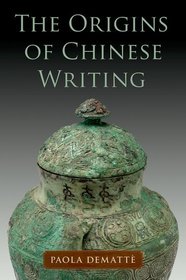
The Origins of Chinese Writing
- Publisher's listprice GBP 102.50
-
46 278 Ft (44 075 Ft + 5% VAT)
The price is estimated because at the time of ordering we do not know what conversion rates will apply to HUF / product currency when the book arrives. In case HUF is weaker, the price increases slightly, in case HUF is stronger, the price goes lower slightly.
- Discount 10% (cc. 4 627 Ft off)
- Discounted price 41 651 Ft (39 668 Ft + 5% VAT)
Subcribe now and take benefit of a favourable price.
Subscribe
46 278 Ft

Availability
printed on demand
Why don't you give exact delivery time?
Delivery time is estimated on our previous experiences. We give estimations only, because we order from outside Hungary, and the delivery time mainly depends on how quickly the publisher supplies the book. Faster or slower deliveries both happen, but we do our best to supply as quickly as possible.
Product details:
- Publisher OUP USA
- Date of Publication 22 December 2022
- ISBN 9780197635766
- Binding Hardback
- No. of pages480 pages
- Size 243x164x34 mm
- Weight 821 g
- Language English
- Illustrations 85 H/T Illustrations and 20 Line Illustrations 248
Categories
Short description:
This book is an investigation on the prehistoric origins and early historic development of Chinese writing, with a focus on archaeological material.
MoreLong description:
This study explores the evidence for Chinese writing in the late Neolithic (3500-2000 BCE) and early Bronze Age (2000-1250 BCE) periods. Chinese writing is often said to have begun with little incubation during the late Shang period (c. 1300-1045 BCE) in the middle-lower Yellow River Valley area as a sudden independent invention. This explanation runs counter to evidence from Mesopotamia, Egypt, and Mesoamerica that shows that independent developments of writing generally undergo a protracted evolution. It also ignores archaeological data from the Chinese Neolithic and early Bronze Age that reveals the existence of signs comparable to Shang characters.
Paola Demattè takes this data into account to address the issue of what writing is, and when, why, and how it develops, by employing a theory of writing that does not privilege language as a prime mover. It focuses instead on visual systems of communication as well as ideological and socio-economic developments as key elements that promote the eventual development of writing. To understand the processes that led to primary developments of writing, The Origins of Chinese Writing draws from the latest research on the early writing systems of Mesopotamia, Egypt, and Mesoamerica, and other forms of protowriting. The result is a novel and inclusive theoretical approach to the archaeological evidence, grammatological data, and textual sources, an approach that demonstrates that Chinese writing emerged out of a long process that began in the Late Neolithic and continued during the Early Bronze Age.
Highly recommended.
Table of Contents:
Table of content i-iii
List of figures iv-xi
0. Introduction 1-16
0.1 Origins of Chinese writing: the scope of this research
0.2 Theory
0.3 The debate on the origins of Chinese writing: dynamics and timing
0.4 Archaeology and Textual sources
0.5 Goals and limits
0.6 Organization of the book
0.7 A note on terminology
0.8 On phonetic transcriptions.
0.9 Translations
Part I - Theories and philosophies of writing
Chapter 1: The nature of Chinese writing 17-37
1.1 Logographs and ideographs
1.2 Monosyllabism and beyond
1.3 Reading Chinese characters
1.4 Structure of Chinese characters
1.5 Types of characters (orthography)
1.6 Polysemy, homographs and allographs
1.7 Languages, writing, and diglossia
Chapter 2: Western and Chinese philosophers on language and writing 34-85
2.1 Philosophers on language and writing: the European tradition
2.2 Language and writing: Zhou philosophers and the Chinese tradition
2.3 Early etymological and philological enquiries: Erya and Shuowen jiezi
2.4 Traditional narratives on the origins of writing
2.5 The origins of Chinese writing according to the Shuowen jiezi
2.6 Fuxi and the trigrams of the Yijing
2.7 Shennong and rope knotting
2.8 Huangdi's minister Cangjie creates the first signs
2.9 Myth on the origins of writing and history
Chapter 3: What is Writing? 86-126
3.1 Verba volant scripta manent
3.2 What is writing? Visual representation, metrology, language
3.3 Imagery and writing: overlappings
3.4 Rock art, pre-historic art: signs, scenes, and narratives
3.5 Early writing and numbers
3.6 Early writing and language recording
3.7 Writing's origins: evolution or invention?
3.8 Origins of Chinese writing: looking at the earliest signs
Part II - The Neolithic Evidence
Chapter 4: Early and Middle Neolithic Signs to the Fourth millennium BCE 127-170
4.1 The Neolithic scenario
4.2 The Paleolithic - Neolithic transition
4.3 The Early Neolithic (8000-5000 BCE): archaeology and signs
4.4 Fifth to Fourth Millennium BCE: Middle Neolithic Signs
4.5 Early symbols in the Yangzi River Valley: Hemudu and Songze
4.6 Shuangdun pictorial signs on pottery
4.7 Signs in the Middle Yangzi Three Gorges and adjacent areas: Daxi (Daixi)
4.8 The Middle Yellow and Wei River Valleys: Yangshao and its signs
4.8.1 Marks on pottery at Yangshao sites
4.8.2 Yangshao marks: previous interpretations
4.8.3 Yangshao signs: conclusions
4.9 Middle and Upper Yellow River valley painted pottery designs
4.10 Gansu and Qinghai area signs: Dadiwan, Majiayao, Banshan, Machang
4.11 The Liao River Valley: Hongshan tri-dimensional signs
4.11.1 Hongshan sites
4.11.2 Hongshan jades
4.12 Conclusions
Chapter 5: The Third Millennium BCE: Late Neolithic Sign Systems 171-237
5.1 The Late Neolithic (3000-2300 BCE) and the Longshan Transition (2300-1900 BCE)
5.2 The Lower Yellow River Valley and Coastal Areas: Dawenkou
5.3.1 Dawenkou sites with graphs
5.3.2 Dawenkou graphs: structural analysis
5.3.3 Dawenkou signs: the archaeological evidence
5.5 The lower Yangzi River valley and delta area: Liangzhu
5.5.1 Inscribed Liangzhu jades: collections and provenance
5.3.2 Liangzhu jade graphs: structure, types and previous interpretations
5.5.3 Liangzhu graphs: meanings and functions
5.5.4 Liangzhu emblems and decorations: the double-face
5.5.5 Liangzhu pottery marks
5.5.6 Liangzhu signs: conclusions
5.6 The Jianghan - Dongting area: Qujialing and Shijiahe (c. 3200-2000 BCE)
5.6.1 Qujialing and Shijiahe graphs
5.6.2 Shijiahe graphs: analysis
5.7 The Middle and Lower Yellow River Valleys: Shandong Longshan and adjacent sites
5.7.1 Chengziyai
5.7.2 Some controversial “Longshan” material
5.7.3 Longshan era pot-marks beyond Shandong
5.8 The Fen River Valley: the city of Taosi
5.9 Conclusion: A Late Neolithic graphic community
Part III - The Bronze Age Evidence
Chapter 6: The Second Millennium BCE: Early and Middle Bronze Age Writing 238-322
6.1 Bridging the evidence: from Late Neolithic to Bronze Age signs
6.2 Bronze Age: the archaeological record
6.3 Sign making during Early Bronze Age: Erlitou
6.4 Writing in the Middle Bronze Age: Shang and beyond
6.4.1 Early to Late Shang period pottery graphs
6.4.2 Meaning and function of Bronze Age pottery graphs
6.5 Shang ritual bronzes and their inscriptions
6.5.1 Ritual bronzes: origin, function, decorations
6.5.2 The making of ritual bronzes and bronze inscriptions
6.5.3 Jinwen: emblem graphs and standard script
6.5.4 Early and Middle Shang bronze inscriptions
6.5.5 Late Shang bronze inscriptions
6.5.6 Taotie, kui, long and other bronze decorations
6.6 Shang inscriptions on shells and bones: oracle bones and beyond
6.6.1 Bone preparations and divination procedures
6.6.2 The practice of bone writing
6.6.3 Divinatory inscriptions
6.6.4 Non-divinatory bone texts: bureaucratic records and writing instruction
6.6.5 Shang sites with oracle bone inscriptions
6.7 Late Shang inscriptions on jade and stone
6.8 Conclusions
Chapter 7: Characteristics of Shang Writing 323-356
7.1 Number and types of graphs
7.2 Structures: simple and compound graphs
7.3 Ancient phonology
7.4 Contractions and shorthand practices
7.5 Extensions of meaning, phonetic loans, and semanto-phonetic compounds
7.6 Script development and variant forms
7.7 Grammar and word classes
7.8 Numerals and numerical systems
7.9 Lexicon
7.10 Direction of script, orientation of characters, and calligraphy
7.11 Literacy during the Bronze Age
7.12 Conclusions
Chapter 8: The origins of Chinese writing 357-384
8.1 The emergence of writing in China: the Neolithic
8.2 Late Neolithic interactions
8.3 Urbanism and sociopolitical complexity
8.4 Transition into the Bronze Age: long distance trade, agriculture, and the calendar
8.5 Writing in the Bronze Age: presence and absence
8.6 King Wuding, divination and the surge of Late Shang writing
8.7 Conclusions: the materiality of writing.
Bibliography

