

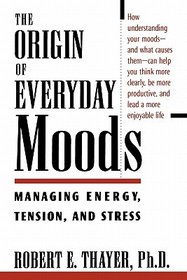
The Origin of Everyday Moods
Managing Energy, Tension, and Stress
- Publisher's listprice GBP 39.49
-
18 866 Ft (17 967 Ft + 5% VAT)
The price is estimated because at the time of ordering we do not know what conversion rates will apply to HUF / product currency when the book arrives. In case HUF is weaker, the price increases slightly, in case HUF is stronger, the price goes lower slightly.
- Discount 10% (cc. 1 887 Ft off)
- Discounted price 16 979 Ft (16 170 Ft + 5% VAT)
Subcribe now and take benefit of a favourable price.
Subscribe
18 866 Ft

Availability
printed on demand
Why don't you give exact delivery time?
Delivery time is estimated on our previous experiences. We give estimations only, because we order from outside Hungary, and the delivery time mainly depends on how quickly the publisher supplies the book. Faster or slower deliveries both happen, but we do our best to supply as quickly as possible.
Product details:
- Edition number New ed
- Publisher OUP USA
- Date of Publication 8 January 1998
- ISBN 9780195118056
- Binding Paperback
- No. of pages288 pages
- Size 233x154x19 mm
- Weight 390 g
- Language English
- Illustrations line figures, tables 0
Categories
Short description:
Snacks. Sex. Shopping. Smoking. Whether we realize it or not, all of us have strategies for self-medicating ourselves when we feel threatened or overwhelmed by tension or tiredness. But why do people respond to pressure in such different ways? And what really helps most to reduce tension and increase energy, a brisk ten-minute walk, twenty minutes of meditation, or two hours of watching TV?
In this fascinating new book, Robert E. Thayer serves as an expert guide through the latest scientific research into moods and mood management, revealing which behaviours energize and empower us, and which sabotage our best interests. (Just five or ten minutes of walking, for example, can enhance mood for an hour or more, while sugar snacking, Thayer shows, causes more tension than it reduces.) Far from a shallow quick fix book, Everyday Moods: Energy and Tension brings readers to a new understanding of the underlying biology of their daily cycles of energy and tension, and offers powerful recommendations for breaking self-destructive habits and leading a richer, more enjoyable life.
Long description:
Caffeine. Candy. Sex. Shopping. Smoking. Whether we realize it or not, all of us have strategies for self-medicating ourselves when we feel threatened or overwhelmed by tension or tiredness. But why does one person respond to pressure by going for a five-mile run, while another indulges in a five-hour drinking marathon? Why do some of us crave companionship, while others just want to be alone? And what really helps most to reduce tension and increase energy, a brisk ten-minute walk, twenty minutes of meditation, or two hours of watching TV?
In this fascinating new book, nationally known psychologist Robert E. Thayer serves as an expert guide through the latest research into moods and mood management, offering proven techniques for putting today's most important breakthroughs to work in our day-to-day lives. Thayer, whose own work on the biopsychology of moods has been widely discussed in the leading scientific journals - as well as in the pages of Reader's Digest, Prevention, USA Today, McCall's, Good Housekeeping, Men's Health, Redbook, and hundreds of other magazines and newspapers - evaluates the hard scientific evidence as he reveals which behaviors energize and empower us, and which sabotage our best interests. (Just five or ten minutes of walking, for example, can enhance mood for an hour or more, while sugar snacking, Thayer shows, causes more tension than it reduces.) Thayer argues that when we learn to see moods as vital barometers of our whole psychology and physiology, rather than mysterious, purely emotional reactions to events around us, we not only understand ourselves better, we have the opportunity to substantially improve our personal effectiveness, both mentally and physically. Thayer offers compelling evidence that our moods - particularly feelings of energy and tension - are closely tied to the rhythms of our evolutionary past. They are directly affected by our health, the food we eat, the amount of sleep we get, exercise (or lack of it), and the time of day. We learn why problems seem more serious late at night, and why a simple disagreement with a co-worker or spouse is more apt to turn into an emotional flare-up at certain times of day. We investigate key differences in the most common ways men and women deal with bad moods, and probe the implications of these findings on our understanding of alcoholism and depression.
Far from a shallow quick fix book, Everyday Moods: Energy and Tension is an in-depth exploration of the origins and influences of moods that affect us every day of our lives. It brings readers to a new understanding of the underlying biology of their daily cycles of energy and tension, and offers powerful recommendations for breaking self-destructive habits and leading a richer, more enjoyable life.
While writers of "pop psychology" books are notorious for passing off their own unsubstantiated notions as scientific fact, Thayer is careful to avoid this trap. The book is readable and easily digestible by nonscientists, while for those who want to know more about the scientific background there is a comprehensive series of notes and full references.
Table of Contents:
Part 1: Introduction
Ch. 1. Mood and Its Meanings
Ch. 2. A Theory of Mood
Ch. 3. Moods as Barometers of General Condition
Ch. 4. The Relationship Between Mood and Thoughts
Ch. 5. Energy and Tension Changes with PMS, Drugs, Social Interaction, Weather, and Life Events
Ch. 6. How Energy and Tension Interact
Ch. 7. The Evolutionary Biology of Moods
Ch. 8. The Physiology and Anatomy of Mood
Part 2: The Self-regulation of Mood
Ch. 9. Self-regulation: Why, How, and How Effective?
Ch. 10. Individual Differences in Mood-regulating Strategies
Ch. 11. Mood Substitution: Different Ways of Getting the Same Mood
Ch. 12. Rational Mood Substitution: Exercise More and Indulge Less
Part 3: Optimal Mood Management
Ch. 13. The Practical Psychology of Self-Regulation
Ch. 14. Overcoming Tense-tiredness Through Energy Enhancement
Ch. 15. Reducing Tension to Overcome Tense-Tiredness
Ch. 16. Moods at Different Times of Day
Ch. 17. Systematic Self-observation: The First Step in Mood Change
Ch. 18. The Origin and Self-regulation of Everyday Moods: A Review
Appendix. Beyond Stress Management to Calm-energy
Notes
Index

