

- Publisher's listprice GBP 9.99
-
4 510 Ft (4 295 Ft + 5% VAT)
The price is estimated because at the time of ordering we do not know what conversion rates will apply to HUF / product currency when the book arrives. In case HUF is weaker, the price increases slightly, in case HUF is stronger, the price goes lower slightly.
- Discount 10% (cc. 451 Ft off)
- Discounted price 4 059 Ft (3 866 Ft + 5% VAT)
Subcribe now and take benefit of a favourable price.
Subscribe
4 510 Ft

Availability
Permanently out of stock
Why don't you give exact delivery time?
Delivery time is estimated on our previous experiences. We give estimations only, because we order from outside Hungary, and the delivery time mainly depends on how quickly the publisher supplies the book. Faster or slower deliveries both happen, but we do our best to supply as quickly as possible.
Product details:
- Publisher OUP USA
- Date of Publication 25 October 2012
- ISBN 9780199760282
- Binding Paperback
- No. of pages168 pages
- Size 170x109x12 mm
- Weight 136 g
- Language English
- Illustrations 10 b/w halftones 0
Categories
Short description:
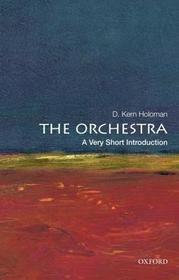
The Orchestra: A Very Short Introduction considers the structure, roots, and day-to-day functioning of the modern philharmonic society. Far from an anachronistic organization that cannot long survive, it is shown to be powerful political and social force, occupying critical positions in cultural diplomacy, national identity, and civic pride.
MoreLong description:
In this Very Short Introduction, D. Kern Holoman considers the structure, roots, and day-to-day functioning of the modern philharmonic society. He explores topics ranging from the life of a musician in a modern orchestra, the recent wave of new hall construction from Berlin to Birmingham, threats of bankruptcies and strikes, and the eyebrow-raising salaries of conductors and general managers. At the heart of the book lies a troubling pair of questions: Can such a seemingly anachronistic organization long survive? Does the symphony matter in contemporary culture? Holoman responds to both with a resounding yes. He shows that the orchestra remains a potent political and social force, a cultural diplomat par excellence. It has adapted well to the digital revolution, and it continues to be seen as an essential element of civic pride. In a time of upheaval in how classical music is created, heard, distributed, and evaluated, the orchestra has managed to retain its historic role as a meeting place of intellectual currents, an ongoing forum for public enlightenment.
ABOUT THE SERIES: The Very Short Introductions series from Oxford University Press contains hundreds of titles in almost every subject area. These pocket-sized books are the perfect way to get ahead in a new subject quickly. Our expert authors combine facts, analysis, perspective, new ideas, and enthusiasm to make interesting and challenging topics highly readable.
Table of Contents:
Chapter 1: Philharmonia
Chapter 2: Musicians
Chapter 3: Venue
Chapter 4: Money
Chapter 5: Conductors
Chapter 6: Repertoire
Chapter 7: Commentary
Chapter 8: Records
Chapter 9: Peace
Epilogue: Civics
References
Further Reading
Index

