

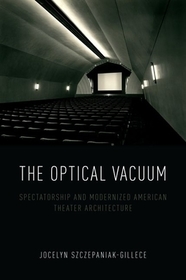
The Optical Vacuum
Spectatorship and Modernized American Theater Architecture
- Publisher's listprice GBP 96.00
-
45 864 Ft (43 680 Ft + 5% VAT)
The price is estimated because at the time of ordering we do not know what conversion rates will apply to HUF / product currency when the book arrives. In case HUF is weaker, the price increases slightly, in case HUF is stronger, the price goes lower slightly.
- Discount 10% (cc. 4 586 Ft off)
- Discounted price 41 278 Ft (39 312 Ft + 5% VAT)
Subcribe now and take benefit of a favourable price.
Subscribe
45 864 Ft

Availability
printed on demand
Why don't you give exact delivery time?
Delivery time is estimated on our previous experiences. We give estimations only, because we order from outside Hungary, and the delivery time mainly depends on how quickly the publisher supplies the book. Faster or slower deliveries both happen, but we do our best to supply as quickly as possible.
Product details:
- Publisher OUP USA
- Date of Publication 30 August 2018
- ISBN 9780190689353
- Binding Hardback
- No. of pages210 pages
- Size 160x236x17 mm
- Weight 476 g
- Language English
- Illustrations 45 illustrations 0
Categories
Short description:
From the 1920s-1960s, American cinematic architecture underwent a seismic shift: movie theaters were neutralized for immersive watching, in large part by architect and writer Benjamin Schlanger. The Optical Vacuum examines how Schlanger reformed both theater and spectator, demonstrating that the essence of film viewing can be found in theatrical space.
MoreLong description:
Between the 1920s and the 1960s, American mainstream cinematic architecture underwent a seismic shift. From the massive movie palace to the intimate streamlined theater, movie theaters became neutralized spaces for calibrated, immersive watching. Leading this charge was New York architect Benjamin Schlanger, a fiery polemicist whose designs and essays reshaped how movies were watched. In its close examination of Schlanger's work and of changing patterns of spectatorship, this book reveals that the essence of film viewing lies not only in the text, but in the spaces where movies are shown. The Optical Vacuum demonstrates that our changing models of cinephilia are always determined by physical structure: from the decorations of the palace to the black box of the contemporary auditorium, variations in movie theater design are icons for how viewing has similarly transformed.
Szczepaniak-Gillece's book on exhibition history tells an utterly captivating and theoretically complex story of the architectonics of theatrical space and its impact on spectatorial attention and absorption. The Optical Vacuum makes a stunning contribution to the vibrant field of Screen Studies, arguing that design can never be divorced from the viewing experiences imagined by cinephiles as well as the doyens of modernism.
Table of Contents:
Introduction: The Theater, the Film, and the Spectator
Chapter One: Nostalgia for the Dark - Ben Schlanger and the Beginning of Neutralization, 1920-1932
Chapter Two: A Field of Light - Optics and the Demasked Screen, 1932-1952
Chapter Three: A Mobile Gaze Through Time & Space: Neutralization in the Era of Widescreen, 1950-1960
Chapter Four: Cinephilia in Ruins: An Audience of the Elite, 1960-1970
Coda
Index

