

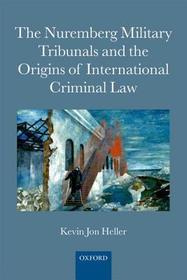
The Nuremberg Military Tribunals and the Origins of International Criminal Law
- Publisher's listprice GBP 62.00
-
27 993 Ft (26 660 Ft + 5% VAT)
The price is estimated because at the time of ordering we do not know what conversion rates will apply to HUF / product currency when the book arrives. In case HUF is weaker, the price increases slightly, in case HUF is stronger, the price goes lower slightly.
- Discount 10% (cc. 2 799 Ft off)
- Discounted price 25 194 Ft (23 994 Ft + 5% VAT)
Subcribe now and take benefit of a favourable price.
Subscribe
27 993 Ft

Availability
printed on demand
Why don't you give exact delivery time?
Delivery time is estimated on our previous experiences. We give estimations only, because we order from outside Hungary, and the delivery time mainly depends on how quickly the publisher supplies the book. Faster or slower deliveries both happen, but we do our best to supply as quickly as possible.
Product details:
- Publisher OUP Oxford
- Date of Publication 11 October 2012
- ISBN 9780199668168
- Binding Paperback
- No. of pages528 pages
- Size 234x178x28 mm
- Weight 796 g
- Language English 0
Categories
Short description:
Less famous than the Nuremberg International Military Tribunal but no less important, the Nuremberg Military Tribunals tried lower-level functionaries and private citizens for their parts in WW II. This book gives a full overview of these trials and it traces the critical role they have played in the development of international criminal law.
MoreLong description:
This book provides the first comprehensive legal analysis of the twelve war crimes trials held in the American zone of occupation between 1946 and 1949, collectively known as the Nuremberg Military Tribunals (NMTs). The judgments the NMTs produced have played a critical role in the development of international criminal law, particularly in terms of how courts currently understand war crimes, crimes against humanity, and the crime of aggression. The trials are also of tremendous historical importance, because they provide a far more comprehensive picture of Nazi atrocities than their more famous predecessor, the International Military Tribunal at Nuremberg (IMT). The IMT focused exclusively on the 'major war criminals'-the Goerings, the Hesses, the Speers. The NMTs, by contrast, prosecuted doctors, lawyers, judges, industrialists, bankers-the private citizens and lower-level functionaries whose willingness to take part in the destruction of millions of innocents manifested what Hannah Arendt famously called 'the banality of evil'.
The book is divided into five sections. The first section traces the evolution of the twelve NMT trials. The second section discusses the law, procedure, and rules of evidence applied by the tribunals, with a focus on the important differences between Law No. 10 and the Nuremberg Charter. The third section, the heart of the book, provides a systematic analysis of the tribunals' jurisprudence. It covers Law No. 10's core crimes-crimes against peace, war crimes, and crimes against humanity-as well as the crimes of conspiracy and membership in a criminal organization. The fourth section then examines the modes of participation and defenses that the tribunals recognized. The final section deals with sentencing, the aftermath of the trials, and their historical legacy.
Heller's book is a result of an exhaustive, meticulous study and research ... It fills a big gap in today's understanding of the Nuremburg Military Tribunals, identifying for ICL and IHL lawyers those substantive and procedural points of interest in the NMTs jurisprudence, which are still relevant despite more that 60 years that passed since the tribunals' conduct.
Table of Contents:
Introduction
The Origins of the Zonal Trials
The OCC and the Tribunals
The Evolution of the Trial Program
The Trials
Jurisdiction and Legal Character of the Tribunals
Evidence
Procedure
Crimes Against Peace
War Crimes
Crimes Against Humanity
Modes of Participation
Conspiracy, Enterprise Liability, and Criminal Membership
Defenses
Sentencing
Aftermath
Legacy
Conclusion
Appendix A: Table of Defendants
Appendix B: Charter of the International Military Tribunal
Appendix C: Control Council Law No. 10
Appendix D: Ordinance No. 7
Appendix E: Uniform Rules of Procedure

