

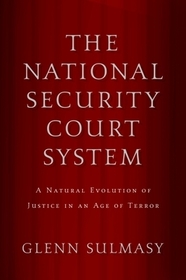
The National Security Court System
A Natural Evolution of Justice in an Age of Terror
- Publisher's listprice GBP 38.99
-
18 627 Ft (17 740 Ft + 5% VAT)
The price is estimated because at the time of ordering we do not know what conversion rates will apply to HUF / product currency when the book arrives. In case HUF is weaker, the price increases slightly, in case HUF is stronger, the price goes lower slightly.
- Discount 10% (cc. 1 863 Ft off)
- Discounted price 16 764 Ft (15 966 Ft + 5% VAT)
Subcribe now and take benefit of a favourable price.
Subscribe
18 627 Ft

Availability
printed on demand
Why don't you give exact delivery time?
Delivery time is estimated on our previous experiences. We give estimations only, because we order from outside Hungary, and the delivery time mainly depends on how quickly the publisher supplies the book. Faster or slower deliveries both happen, but we do our best to supply as quickly as possible.
Product details:
- Publisher OUP USA
- Date of Publication 15 October 2009
- ISBN 9780195379815
- Binding Hardback
- No. of pages256 pages
- Size 236x163x22 mm
- Weight 499 g
- Language English 0
Categories
Short description:
In the last few years, military courts, military commissions, Gitmo, and 'Hamdan' have become stock terms on the front pages of America's leading newspapers. But how much do we really know about the larger system they function in? Does it work well, or is it a disaster? Glenn Sulmasy, probably the nation's leading expert on the topic of military commissions and national security courts, explains how the system originated, how it operates, and why it is beset by so many problems and so much controversy. He begins by charting the court system's historical trajectory up to the current predicament. The recent Boumediene v. Bush decision, which tossed aside the dysfunctional national court system envisioned by the Bush administration and upheld the right of habeas corpus for detainees, promises to throw national security law into chaos, and will also probably lead to the closing of Guantanamo. Arguing that there needs to sensible approach to the global war on terror's unique set of prisoners, Sulmasy closes with a reasonable "third way" solution that tacks between doubling down and shuttering the court system. He instead advocates creating a separate standing judicial system that allows for habeas corpus appeals and which focuses exclusively on existing war-on-terror cases as well the inevitable cases that will arise in coming years. Authoritative, clear, and tightly argued, this book will be the definitive work on the subject.
MoreLong description:
The recent Boumediene v. Bush decision, which tossed aside the dysfunctional military court system envisioned by the Bush administration and upheld the right of habeas corpus for detainees, promises to throw national security law into chaos, and will also probably lead to the closing of Guantanamo. In this timely and much-needed book, Glenn Sulmasy, one of America's leading experts on national security law, opens with a much-needed history of America's long and complicated experience with such courts since the early days of the Republic. After tracing their evolution in the contemporary era, Sulmasy argues for a more sensible approach to the global war on terror's unique set of prisoners. He proposes a reasonable "third way" solution that avoids even more extreme measures, on the one hand, and a complete shuttering of the court system, on the other. Instead, he advocates creating a separate standing judicial system, overseen by civilian judges, that allows for habeas corpus appeals and which focuses exclusively on existing war-on-terror cases as well as the inevitable cases to come. For all those who want to explore the crucial legal issues behind the headlines about Gitmo and the rights of detainees, The National Security Court System offers a clear-headed assessment of where we are and where we ought to be going.
MoreTable of Contents:
Introduction
The Original Intent of Military Commissions
Military Commissions in U.S. History
The Second World War Military Commision - Ex Parte Quirin, et al
The War on al Qaeda and the Military Order of November 13, 2001
Hamdan and the Military COmmissions Act of 2006
The Legal Landscape After oumediene
The National Security Court System
Conclusion

