

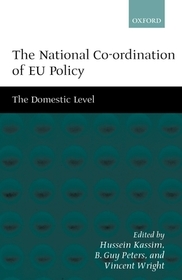
The National Co-ordination of EU Policy
The Domestic Level
- Publisher's listprice GBP 180.00
-
81 270 Ft (77 400 Ft + 5% VAT)
The price is estimated because at the time of ordering we do not know what conversion rates will apply to HUF / product currency when the book arrives. In case HUF is weaker, the price increases slightly, in case HUF is stronger, the price goes lower slightly.
- Discount 10% (cc. 8 127 Ft off)
- Discounted price 73 143 Ft (69 660 Ft + 5% VAT)
Subcribe now and take benefit of a favourable price.
Subscribe
81 270 Ft

Availability
printed on demand
Why don't you give exact delivery time?
Delivery time is estimated on our previous experiences. We give estimations only, because we order from outside Hungary, and the delivery time mainly depends on how quickly the publisher supplies the book. Faster or slower deliveries both happen, but we do our best to supply as quickly as possible.
Product details:
- Publisher OUP Oxford
- Date of Publication 3 August 2000
- ISBN 9780198296645
- Binding Hardback
- No. of pages380 pages
- Size 242x164x20 mm
- Weight 589 g
- Language English 0
Categories
Short description:
This book i sone of two volumes in which leading scholars examine the way in which EU member states co-ordinate their European policies. Eschewing the 'Europeanisation' problematic within which the issue is usually adressed, this book adopts a broader, more inclusive approach. It examines domestic processes and investigates co-ordination in ten member states - Austria, Belgium, Denmark, France, Germany, Greece, Italy, Portugal, Spain and the United Kingdom - looking at co-ordinating ambitions, the actors involved in EU policy making, and the structures and processes by which policy is made.
The companion volume answers similar questions about national administrations in Brussels. Looking at twelve member states, it is the first systematic examination of the role played by Permanent Representations in national EU policy making.
Long description:
This book i sone of two volumes in which leading scholars examine the way in which EU member states co-ordinate their European policies. Eschewing the 'Europeanisation' problematic within which the issue is usually adressed, this book adopts a broader, more inclusive approach. It examines domestic processes and investigates co-ordination in ten member states - Austria, Belgium, Denmark, France, Germany, Greece, Italy, Portugal, Spain and the United Kingdom - looking at co-ordinating ambitions, the actors involved in EU policy making, and the structures and processes by which policy is made.
From a comparative perspective, the book identifies and assesses the impact of the influiences that have shaped systems of national co-ordination - the demands exerted by Union membership, the instituional structure of the national polity, the pre-existing balance between domestic institutions, administrative norms and values, and attitudes, both popular and elite, the European integration. It assesses the extent to which there has been a convergent response to the administrative challenges posed by membership on the part of the member states or whether a pattern of divergence emerges. The effectiveness of member states in influencing policy outcomes at the European level is also addressed.
The companion volume answers similar questions about national administrations in Brussels. Looking at twelve member states, it is the first systematic examination of the role played by Permanent Representations in national EU policy making.
This is an outstanding edited volume ... All essays are of a high standard ... The clear presentation of the facts and theoretical arguments make this book essential reading for a wide variety of audiences whether practitioner, student or academic, and for those interested in the domestic politico-administrative system of the 11 member states covered by the book or in decision-making in the EU.

