

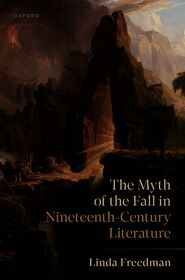
The Myth of the Fall in Nineteenth-Century Literature
- Publisher's listprice GBP 99.00
-
44 698 Ft (42 570 Ft + 5% VAT)
The price is estimated because at the time of ordering we do not know what conversion rates will apply to HUF / product currency when the book arrives. In case HUF is weaker, the price increases slightly, in case HUF is stronger, the price goes lower slightly.
- Discount 10% (cc. 4 469 Ft off)
- Discounted price 40 229 Ft (38 313 Ft + 5% VAT)
Subcribe now and take benefit of a favourable price.
Subscribe
44 698 Ft

Availability
Estimated delivery time: In stock at the publisher, but not at Prospero's office. Delivery time approx. 3-5 weeks.
Not in stock at Prospero.
Why don't you give exact delivery time?
Delivery time is estimated on our previous experiences. We give estimations only, because we order from outside Hungary, and the delivery time mainly depends on how quickly the publisher supplies the book. Faster or slower deliveries both happen, but we do our best to supply as quickly as possible.
Product details:
- Publisher OUP Oxford
- Date of Publication 15 August 2025
- ISBN 9780198969570
- Binding Hardback
- No. of pages304 pages
- Size 240x165x22 mm
- Weight 648 g
- Language English
- Illustrations 14 b&w halftones 612
Categories
Short description:
The Myth of the Fall in Nineteenth-Century Literature offers fresh close readings of both canonical and less well-known works and is divided into two parts, fiction-making and nation-building, addressing social, political, and historical issues as well as literary value and the relationships between literature, religion, and the visual arts.
MoreLong description:
Why does the myth of the Fall continue to matter in an increasingly secularised world?
Why do we continue to imagine a point where everything went wrong, and why must we imagine that things were once better than they are now?
Modern political theodicies repeatedly play to the myth of the Fall as empowering human authorship, promising to 'take back control' or 'make America great again'. The myth of the Fall is so absorbed into western culture that we sometimes don't even notice it's there, let alone think about why and how it has persisted through secularisation. It is often pernicious, playing on feelings of innate supremacy and lost dominion. Linda Freedman shows that it is also creative, the first act of disobedience and resistance which set new human stories in motion and gave narrative shape to existence.
Nineteenth-century writers were so steeped in Christian traditions that the Fall remained an ineluctable structure of thought and even those who resisted or tried to secularise its doctrinal orthodoxies tended to affirm its logic. It was a political, social, and cultural force as well as an aesthetic preoccupation, a way of reflecting on the limitations and possibilities of art and literature, driving innovations in prose, poetry, and the novel.
Rethinking narratives of American exceptionalism with transatlantic and anti-racist writings, Freedman captures some of the most theologically imaginative and aesthetically and politically interesting textures of the Fall in nineteenth-century literature. The myth of the Fall survives as much more than a judgmental and repressive social mechanism and mattered to people living vastly different lives--this is partly due to the adaptability and force of its narrative logic and partly because it gives narrative time the feel of a quest, an infinite search for meaning. The Fall holds onto the otherworldly and the unworldly. It serves as a formal metalanguage, a residually, and sometimes explicitly, religious aesthetic, an origin myth of modernity--a source for being in time.
Table of Contents:
Introduction
Part 1: Fiction-Making
The Fall into Culture: Rousseau, Writing and Catastrophe
Fallen Forms: Blake's Comedy of Errors
Errancy, Accident and Desire: Dickinson's Open Endings
'This World of Mistakes': Eliot and Moral Choice
Part 2: Nation-Building
Textures of a New Eden: Cole, Emerson, Whitman
The Violence of Cain: Wilson, Brown, Truth
Tracing the Old Eden: Ruskin, Newman, Hopkins
Epilogue

