

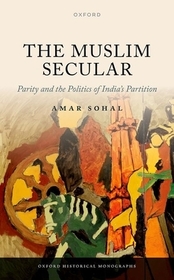
The Muslim Secular
Parity and the Politics of India's Partition
Series: Oxford Historical Monographs;
- Publisher's listprice GBP 88.00
-
39 732 Ft (37 840 Ft + 5% VAT)
The price is estimated because at the time of ordering we do not know what conversion rates will apply to HUF / product currency when the book arrives. In case HUF is weaker, the price increases slightly, in case HUF is stronger, the price goes lower slightly.
- Discount 10% (cc. 3 973 Ft off)
- Discounted price 35 759 Ft (34 056 Ft + 5% VAT)
Subcribe now and take benefit of a favourable price.
Subscribe
39 732 Ft

Availability
Estimated delivery time: In stock at the publisher, but not at Prospero's office. Delivery time approx. 3-5 weeks.
Not in stock at Prospero.
Why don't you give exact delivery time?
Delivery time is estimated on our previous experiences. We give estimations only, because we order from outside Hungary, and the delivery time mainly depends on how quickly the publisher supplies the book. Faster or slower deliveries both happen, but we do our best to supply as quickly as possible.
Product details:
- Publisher OUP Oxford
- Date of Publication 31 August 2023
- ISBN 9780198887638
- Binding Hardback
- No. of pages352 pages
- Size 225x140x25 mm
- Weight 528 g
- Language English 416
Categories
Short description:
This book explores the political thought of three key Muslim thinker-actors associated with the Indian freedom struggle: Abul Kalam Azad, Sheikh Abdullah, and Abdul Ghaffar Khan. These men sought to maintain Muslim minority rights and influence within a postcolonial, united India.
MoreLong description:
Concerned with the fate of the minority in the age of the nation-state, Muslim political thought in modern South Asia has often been associated with religious nationalism and the creation of Pakistan. The Muslim Secular complicates that story by reconstructing the ideas of three prominent thinker-actors of the Indian freedom struggle: the Indian National Congress leader Abul Kalam Azad, the popular Kashmiri politician Sheikh Abdullah, and the nonviolent Pashtun activist Abdul Ghaffar Khan. Revising the common view that they were mere acolytes of their celebrated Hindu colleagues M.K. Gandhi and Jawaharlal Nehru, this book argues that these three men collectively produced a distinct Muslim secularity from within the grander family of secular Indian nationalism; an intellectual tradition that has retained religion within the public space while nevertheless preventing it from defining either national membership or the state. At a time when many across the decolonising world believed that identity-based majorities and minorities were incompatible and had to be separated out into sovereign equals, Azad, Abdullah, and Ghaffar Khan thought differently about the problem of religious pluralism in a postcolonial democracy. The minority, they contended, could conceive of the majority not just as an antagonistic entity that is set against it, but to which it can belong and uniquely complete. Premising its claim to a single, united India upon the universalism of Islam, champions of the Muslim secular mobilised notions of federation and popular sovereignty to replace older monarchical and communitarian forms of power. But to finally jettison the demographic inequality between Hindus and Muslims, these thinkers redefined equality itself. Rejecting its liberal definition for being too abstract and thus prone to majoritarian assimilation, they replaced it with their own rendition of Indian parity to simultaneously evoke commonality and distinction between Hindu and Muslim peers. Azad, Abdullah, and Ghaffar Khan achieved this by deploying a range of concepts from profane inheritance and theological autonomy to linguistic diversity and ethical pledges. Retaining their Muslimness and Indian nationality in full, this crowning notion of equality-as-parity challenged both Gandhi and Nehru's abstractions and Mohammad Ali Jinnah's supposedly dangerous demand for Pakistan.
Meticulously researched, intricately argued, and elegantly written. This is a splendid and original contribution to the understanding of the intellectual foundations of Indian nationalism.
Table of Contents:
Introduction
PART I INHERITING HINDUSTAN: ABUL KALAM AZAD AND THE CONGRESS MUSLIMS
Secularism as Culture
The Indian Intoxicant
PART II BEYOND THE REGION: INDIA IN THE POLITICAL THOUGHT OF SHEIKH ABDULLAH AND ABDUL GHAFFAR KHAN
A Three-Nation Theory
An Ethical Country
Conclusion

