

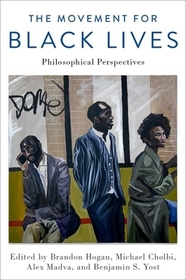
The Movement for Black Lives
Philosophical Perspectives
- Publisher's listprice GBP 91.00
-
41 086 Ft (39 130 Ft + 5% VAT)
The price is estimated because at the time of ordering we do not know what conversion rates will apply to HUF / product currency when the book arrives. In case HUF is weaker, the price increases slightly, in case HUF is stronger, the price goes lower slightly.
- Discount 10% (cc. 4 109 Ft off)
- Discounted price 36 978 Ft (35 217 Ft + 5% VAT)
Subcribe now and take benefit of a favourable price.
Subscribe
41 086 Ft

Availability
printed on demand
Why don't you give exact delivery time?
Delivery time is estimated on our previous experiences. We give estimations only, because we order from outside Hungary, and the delivery time mainly depends on how quickly the publisher supplies the book. Faster or slower deliveries both happen, but we do our best to supply as quickly as possible.
Product details:
- Publisher OUP USA
- Date of Publication 2 February 2022
- ISBN 9780197507773
- Binding Hardback
- No. of pages316 pages
- Size 159x241x25 mm
- Weight 576 g
- Language English 176
Categories
Short description:
The Movement for Black Lives: Philosophical Perspectives brings philosophical analysis to bear on the aims, strategies, policy positions, and intellectual-historical context of the Movement, which has not received the sustained philosophical attention warranted by its political significance. Leading scholars address "Black Lives Matter" as a speech act, the Movement for Black Lives's (M4BL) conception of the value of Black lives, the gender dynamics of M4BL, M4BL's relation to other social justice movements, M4BL's novel forms of leadership and organization, and the impact of racism on the criminal justice system.
MoreLong description:
The Movement for Black Lives (M4BL) has gained worldwide visibility as a grassroots social justice movement distinguished by a decentralized, non-hierarchal mode of organization, and in 2020 Black Lives Matter protests across the country shook America's moral conscience to its core. M4BL rose to prominence in part thanks to its protests against police brutality and misconduct directed at Black Americans. However, its animating concerns are far broader, calling for a wide range of economic, political, legal, and cultural measures to address what it terms a "war against Black people," as well as the "shared struggle with all oppressed people." Yet despite the significance of the social, political, and economic goals of M4BL, as well as the innovative organizational leadership strategies it employs, M4BL has so far received little sustained philosophical attention.
The Movement for Black Lives: Philosophical Perspectives brings philosophical analysis to bear on the aims, strategies, policy positions, and intellectual-historical context of M4BL. Leading scholars tackle such themes as: "Black Lives Matter" as a political speech act, M4BL's conception of the value of Black lives, the gender dynamics of the Movement, the relation of M4BL to other Black liberation movements and transitional justice movements, the Movement's new forms of leadership and organization, and the impact of racism on the normative assessment of the criminal justice system.
The volume broaches a wide range of pressing issues in the philosophy of language, social and political philosophy, philosophy of race, philosophy of gender, and the philosophy of punishment. It is vital reading for students and scholars in the humanities and social sciences interested in race, inequality, and social justice movements.
For scholars and laity in the fields of race studies or philosophy, this book offers an important examination of the theoretical foundations and issues of social and political philosophy. The uniqueness of this book is that the essays offer both support for and critiques of the foundational assumptions and arguments underlying different scholarly/activist positions. The volume also provides a theoretical discussion of how to move away from leadership--oriented activism/scholarship and toward democratic/cooperative-oriented activism/scholarship. Though clearly rooted in philosophy, chapters are accessible to readers of all levels. This would be an excellent book for class discussion and student research.
Table of Contents:
Introduction
Part I - The Value of Black Lives
1. What "Black Lives Matter" Should Mean, Brandon Hogan
2. "And He Ate Jim Crow": Racist Ideology as False Consciousness, Vanessa Wills
3. He Never Mattered: Poor Black Males and the Dark Logic of Intersectional Invisibility, Tommy J. Curry
Part II - Theorizing Racial Justice
4. Reconsidering Reparations: The Movement for Black Lives and Self-Determination, Olúfemi O. Táíwò
5. The Movement for Black Lives and Transitional Justice, Colleen Murphy
Part III - The Language of M4BL
6. Positive Propaganda and the Pragmatics of Protest, Michael Randall Barnes
7. Value-Based Protest Slogans: An Argument for Reorientation, Myisha Cherry
8. The Movement for Black Lives and the Language of Liberation, Ian Olasov
Part IV -M4BL, Anti-Black Racism, and Punishment
9. Can Capital Punishment Survive if Black Lives Matter?, Michael Cholbi and Alex Madva
10. Sentencing Leniency for Black Offenders, Benjamin S. Yost
Part V - Strategy and Solidarity
11. The Violence of Leadership in Black Lives Matter, Dana Francisco Miranda
12. Speaking For, Speaking With, and Shutting Up: Models of Solidarity and the Pragmatics of Truth Telling, Mark Norris Lance
13. Sky's the Limit: A Case-Study in Envisioning Real Anti-Racist Utopias, Keyvan Shafiei

