

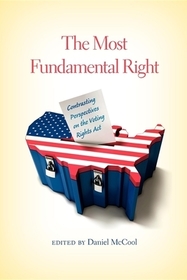
The Most Fundamental Right – Contrasting Perspectives on the Voting Rights Act
Contrasting Perspectives on the Voting Rights Act
- Publisher's listprice GBP 26.99
-
12 894 Ft (12 280 Ft + 5% VAT)
The price is estimated because at the time of ordering we do not know what conversion rates will apply to HUF / product currency when the book arrives. In case HUF is weaker, the price increases slightly, in case HUF is stronger, the price goes lower slightly.
- Discount 10% (cc. 1 289 Ft off)
- Discounted price 11 605 Ft (11 052 Ft + 5% VAT)
Subcribe now and take benefit of a favourable price.
Subscribe
12 894 Ft

Availability
Estimated delivery time: In stock at the publisher, but not at Prospero's office. Delivery time approx. 3-5 weeks.
Not in stock at Prospero.
Why don't you give exact delivery time?
Delivery time is estimated on our previous experiences. We give estimations only, because we order from outside Hungary, and the delivery time mainly depends on how quickly the publisher supplies the book. Faster or slower deliveries both happen, but we do our best to supply as quickly as possible.
Product details:
- Publisher MH – Indiana University Press
- Date of Publication 17 October 2012
- Number of Volumes Print PDF
- ISBN 9780253001948
- Binding Paperback
- No. of pages418 pages
- Size 229x152x22 mm
- Weight 591 g
- Language English 0
Categories
Long description:
Passed in 1965 during the height of the Civil Rights movement, the Voting Rights Act (VRA) changed the face of the American electorate, dramatically increasing minority voting, especially in the South. While portions of the Act are permanent, certain provisions were set to expire in 2007. Reauthorization of these provisions passed by a wide margin in the House, and unanimously in the Senate, but the lopsided tally hid a deep and growing conflict. The Most Fundamental Right is an effort to understand the debate over the Act and its role in contemporary American democracy. Is the VRA the cornerstone of civil rights law that prevents unfair voting practices, or is it an anachronism that no longer serves American democracy? Divided into three sections, the book utilizes a point/counterpoint approach. Section 1 explains the legal and political context of the Act, providing important background for what follows; Section 2 pairs three debates concerning specific provisions or applications of the Act; while Section 3 offers commentaries on the previous chapters from attorneys with widely divergent viewpoints.
More
