

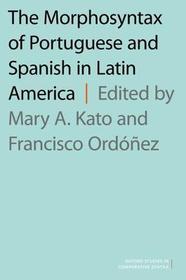
The Morphosyntax of Portuguese and Spanish in Latin America
Series: Oxford Studies in Comparative Syntax;
- Publisher's listprice GBP 48.99
-
22 118 Ft (21 065 Ft + 5% VAT)
The price is estimated because at the time of ordering we do not know what conversion rates will apply to HUF / product currency when the book arrives. In case HUF is weaker, the price increases slightly, in case HUF is stronger, the price goes lower slightly.
- Discount 10% (cc. 2 212 Ft off)
- Discounted price 19 906 Ft (18 959 Ft + 5% VAT)
Subcribe now and take benefit of a favourable price.
Subscribe
22 118 Ft

Availability
Estimated delivery time: In stock at the publisher, but not at Prospero's office. Delivery time approx. 3-5 weeks.
Not in stock at Prospero.
Why don't you give exact delivery time?
Delivery time is estimated on our previous experiences. We give estimations only, because we order from outside Hungary, and the delivery time mainly depends on how quickly the publisher supplies the book. Faster or slower deliveries both happen, but we do our best to supply as quickly as possible.
Product details:
- Publisher OUP USA
- Date of Publication 8 December 2016
- ISBN 9780190465896
- Binding Paperback
- No. of pages384 pages
- Size 160x236x25 mm
- Weight 794 g
- Language English 0
Categories
Short description:
Spanish and Portuguese were Romance languages spoken in the Iberian Peninsula and were brought to America as the languages of the colonizers in the 16th century. Along the centuries, the two languages developed specific properties that distinguish them from the varieties spoken in the Old World. This book offers a rich comparative material which helps us in the understanding of linguistic change and variation.
MoreLong description:
Recent trends in syntax and morphology have shown the great importance of doing research on variation in closely related languages. This book centers on the study of the morphology and syntax of the two major Romance Languages spoken in Latin America from this perspective. The works presented here either compare Brazilian Portuguese with European Portuguese or compare Latin American Spanish and Peninsular Spanish, or simply compare Portuguese and its varieties with Spanish and its varieties. The chapters advance on a great variety of theoretical questions related to coordination, clitics , hyper-raising, infinitives, null objects, null subjects, hyper-raising, passives, quantifiers, pseudo-clefts, questions and distributed morphology. Finally, this book provides new empirical findings and enriches the descriptions made about Portuguese and Spanish Spoken in the Americas by providing new generalizations, new data and new statistical evidence that help better understand the nature of such variation. The studies contained in this book show a vast array of new phenomena in these young varieties, offering empirical and theoretical windows to language variation and change.
MoreTable of Contents:
FOREWORD
Mary A. Kato and Francisco Ordóñez
1. Microparametric variation in varieties of Spanish and Portuguese null subjects
Eugênia Duarte and Humberto Soares da Silva
2. The Null Subject Parameter revisited. The evolution from null subject Spanish and Portuguese to Dominican Spanish and Brazilian Portuguese
José Camacho
3.On the notion of partial (non-) pro-drop in Romance
Andrés Saab
4.Informational quantifier floating: a contrastive analysis between Brazilian
Portuguese and Spanish
Renato Lacerda
5.Subject and Topic Hyper-raising in Brazilian Portuguese: A case study on reference sets for economy computations
Jairo Nunes
6. V-and-V constructions in Portuguese: The case of ir-and-V
Madalena Colaço and Anabela Gonçalves
7. Inflected infinitives and restructuring in Brazilian Portuguese
Marcelo Modesto
8. The Null object in Romania Nova
Sonia Cyrino
9.The external possessor construction in European Portuguese and Brazilian Portuguese
Maria Aparecida Torres Morais and Heloisa Maria Lima-Salles
10.Agreement and D.O.M. with se: A comparative study of Mexican and Peninsular Spanish
Francisco Ordóñez and Esthela Treviño
11.Some syntactic and pragmatic aspects of WH-in-situ in Brazilian Portuguese
Maria Cristina Figueiredo Silva and Elaine Grolla
12.Pseudo-clefts and semi-clefts in Portuguese and Caribbean Spanish
Mary A. Kato and Carlos Mioto
13. From [o[que]] to [o que] in Brazilian Portuguese free relatives: a diachronic perspective
Paulo Medeiros Junior
14. A study of truncated nominal forms in Brazilian Portuguese: their derivation and their relation to non-verbal form classes
Ana Paula Scher
Subject Index
Name Index

