

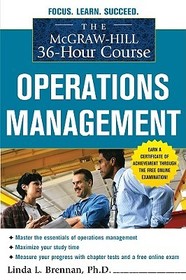
The McGraw-Hill 36-Hour Course: Operations Management
Series: McGraw-Hill 36-Hour Courses;
- Publisher's listprice GBP 19.99
-
9 550 Ft (9 095 Ft + 5% VAT)
The price is estimated because at the time of ordering we do not know what conversion rates will apply to HUF / product currency when the book arrives. In case HUF is weaker, the price increases slightly, in case HUF is stronger, the price goes lower slightly.
- Discount 10% (cc. 955 Ft off)
- Discounted price 8 595 Ft (8 186 Ft + 5% VAT)
Subcribe now and take benefit of a favourable price.
Subscribe
9 550 Ft

Availability
printed on demand
Why don't you give exact delivery time?
Delivery time is estimated on our previous experiences. We give estimations only, because we order from outside Hungary, and the delivery time mainly depends on how quickly the publisher supplies the book. Faster or slower deliveries both happen, but we do our best to supply as quickly as possible.
Product details:
- Publisher McGraw Hill
- Date of Publication 16 October 2010
- ISBN 9780071743839
- Binding Paperback
- No. of pages256 pages
- Size 226x152x12 mm
- Weight 340 g
- Language English 0
Categories
Short description:
More than 150,000 books sold in the 36-Hour series!
A crash course on the critical business practice of operations management
Long description:
Take a crash course in boosting operational efficiency!
Whether a business manufactures trucks, delivers packages, or sells coffee, it lives and breathes on its operations. Without exception. Ensuring smooth, efficient processes is a challenging task--but the rewards are immense.The McGraw-Hill 36-Hour Course: Operations Management puts you on the fast track to bolstering and managing the effectiveness of your organization?s operations. Complete with exercises, self-tests, and an online final exam, this virtual immersion course in operations management teaches you how to:- Evaluate and measure existing systems? performance
- Use quality management tools like Six Sigma and Lean Production
- Design new, improved processes
- Define, plan, and control costs of projects
Take a crash course in boosting operational efficiency!
Whether a business manufactures trucks, delivers packages, or sells coffee, it lives and breathes on its operations. Without exception. Ensuring smooth, efficient processes is a challenging task--but the rewards are immense.The McGraw-Hill 36-Hour Course: Operations Management puts you on the fast track to bolstering and managing the effectiveness of your organization?s operations. Complete with exercises, self-tests, and an online final exam, this virtual immersion course in operations management teaches you how to:- Evaluate and measure existing systems? performance
- Use quality management tools like Six Sigma and Lean Production
- Design new, improved processes
- Define, plan, and control costs of projects
Table of Contents:
PART I. FOUNDATION
Chapter 1
Results over Routine
(Motivation for this Study; Operations as Competitive Advantage, Guiding Principles for Operations, Technique: Identifying Sources of Competitive Advantage)
Chapter 2
Practical Approach
(Systems Thinking,Business Research Framework, Technique: Evaluating Transformation Systems)
Chapter 3
Desired Results
(Bottom-Line Impact, Measurement Theory, Technique: Developing a Balanced Measurement System)
PART II. RESULTS AT THE ORGANIZATIONAL LEVEL
Chapter 4
Organizational Performance
(The Organization as a Value Chain, Product and Service Design, Operational Decision Points, Technique: Using a House of Quality)
Chapter 5
Quality Practices and Continuous Improvement
(Definitions and Origins of Quality Management, Principles and Practices for Quality,Six Sigma Approach, Technique: Performing Problem Determination, Managing for Results,A Practical Approach to Operations Management)
Chapter 6
Technology across the Value Chain
(Product, Process and Information Technologies,Organizational Learning and Knowledge Management,Technique: Applying Maturity Models)
PART III. RESULTS AT THE PROCESS LEVEL
Chapter 7
Process Design
(Defining Processes, Theory of Constraints, Levers for Capacity Management, Technique: Creating Forecasts)
Chapter 8
Process Analysis & Reengineering
(Costs of Quality, Sources of Waste, Reengineering Principles & Pitfalls, Techniques: Developing Flow Charts)
Chapter 9
Process Control
(To Change or Not to Change: Common vs. Assignable Causes,Statistical Process Control and the Beauty of the Normal Distribution, Attributes versus Variables, Chart Mechanics, Process Capability, Implementation Considerations, Technique: Creating and Interpreting Control Charts)
PART IV. ACHIEVING RESULTS
Chapter 10
Project Definition
(Project Success Factors and Career-Ending Moves, Managing Change, Project Initiation, Project Planning, Technique: Developing a Statement of Work)
Chapter 11
Project Control
(Schedule Development, Feasibility Analysis, Communications Management, Project Closings, Technique: Using the Critical Path Method)
Chapter 12
Project Management
(Project Roles and Responsibilities, Ethical and Effective Leadership, Groups versus Teams; Technique: Running Effective Meetings)

